

 Lead Sheet Codes Explained: Code 3 to Code 8A lead code is a number that tells you how thick and heavy a sheet is. This guide sets out codes 3 to 8 and the parts…Guide · 8 min read
Lead Work & Lead Flashing in Crawley
Flashings, valleys, bays and dormers, dressed in lead.
Our lead work covers chimney flashings, step flashings, valleys, back gutters, bay and porch tops, dormer cheeks and small lead roofs across Crawley and Sussex. You get survey photos of your own lead, then a single total in writing.
- Survey photos of your own roof
- One written price
- Repairs, re-roofs and emergencies
- Tidy site, waste taken away
Signs your leadwork is failing
- A damp stain beside the chimney breast
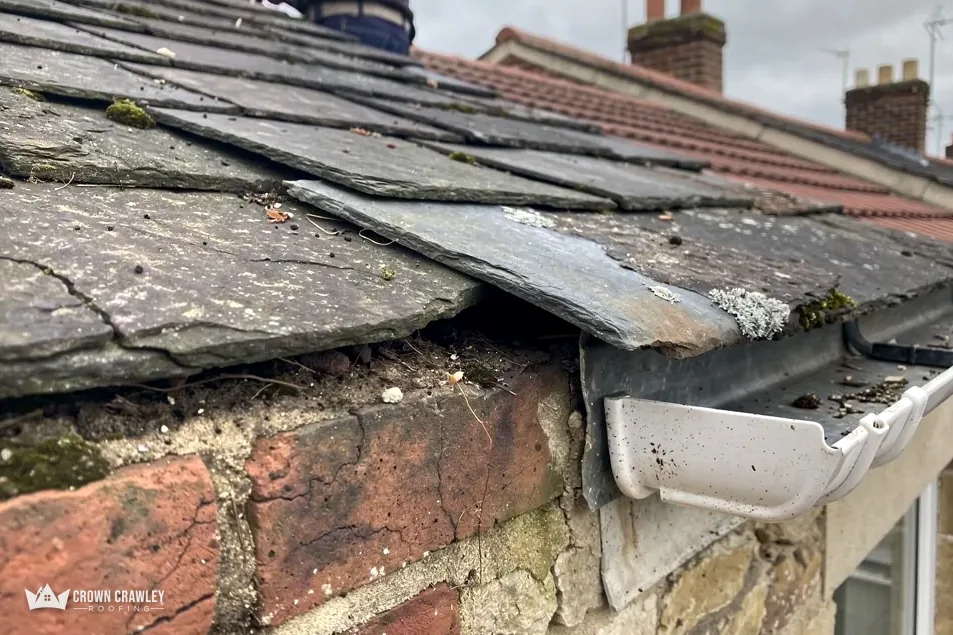
- Lead lifting or curling away from the wall
- Hairline splits or holes in lead sheet
- Missing lead after a theft or storm
- Water marks in a bay or porch ceiling
What our lead work covers
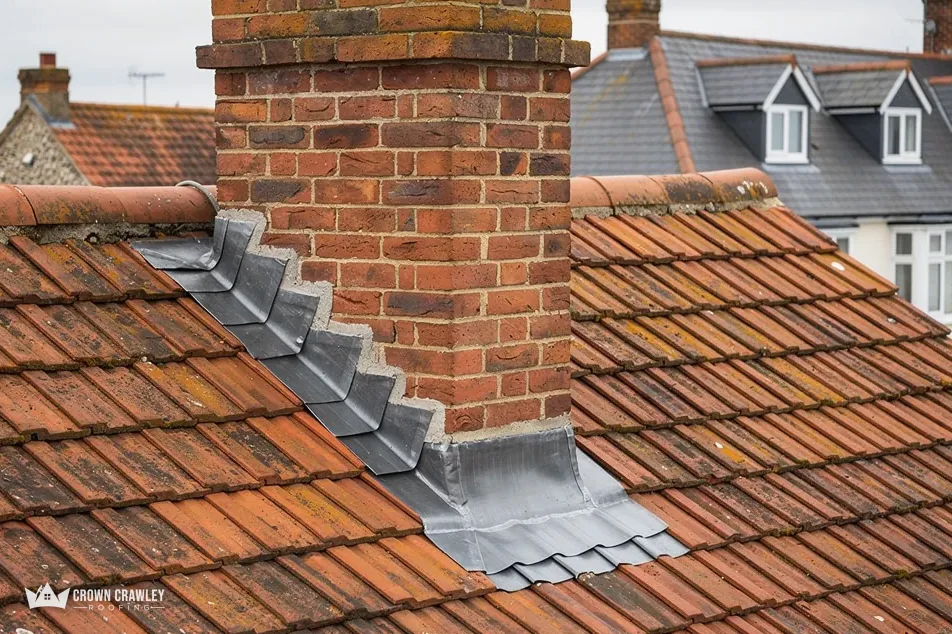
 Chimney flashingsFront aprons, stepped sides and back gutters renewed or repaired so rain stops tracking in beside the stack.
 Step and cover flashingsStepped lead along gable walls and a cover flashing over a lower roof, fixed into the brickwork properly.
 Lead valleysWorn valley linings stripped and relaid in a suitable code of lead, with the boards below checked first.
- Bays, porches and dormersLead tops, rolls and cheeks renewed on bay windows, porch roofs and dormers, with the joins dressed neatly.
 Soakers and abutmentsSmall lead soakers replaced under tiles or slates wherever a slope runs into a wall, so the join stays dry.
 Small lead flat roofsCanopies, lantern bases and dormer tops covered in sheet lead with rolls and drips to carry water off.
Repair, renew or replace the lead?
- RepairThe lead is sound and the fault is a loose edge, a gap or open pointing.
- Renew a sectionOne run has split or lifted, while the rest of the lead still lies well.
- ReplaceThe sheet is worn through along the whole detail, so patching would only delay the leak.
How a leadwork job runs
- 1Tell us where it stainsSend a picture of the stack, wall or valley and say where the damp shows indoors.
- 2A survey up closeWe examine the lead, the joints it is fixed into and the boards beneath, photographing each fault.
- 3Your single written totalThe price arrives as one sum, next to your survey photos, with the likely cause set out simply.
- 4Repair, then a final lookWe fix the detail, inspect the junction and the room below for damp, and email the after photos.
The lead work diary
Inside a leadwork repair
Six stages of a lead job around Crawley, starting with the flashing seen from the lawn and ending at the ceiling below.
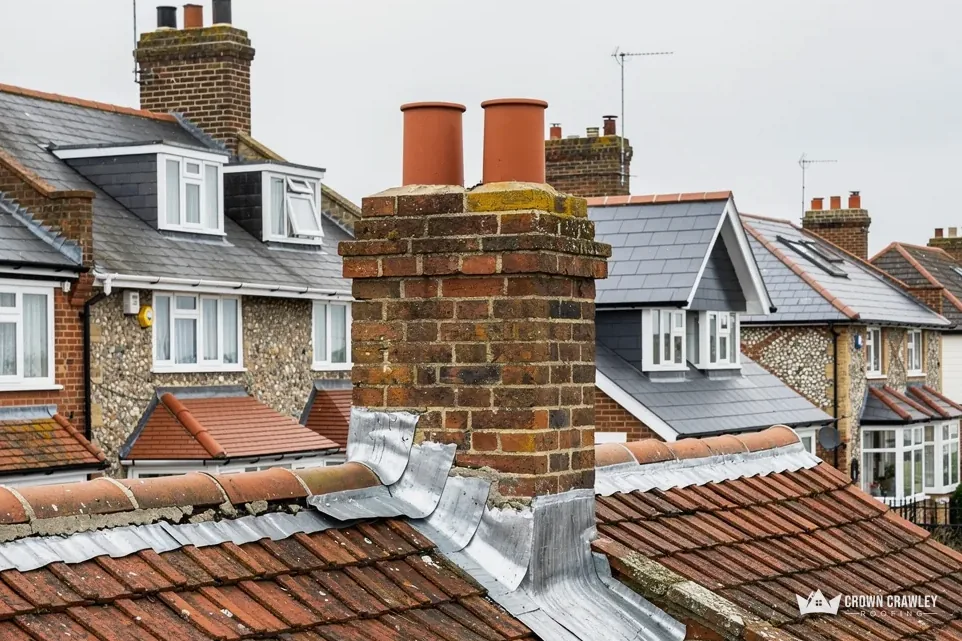
Stage 01 · First look
Lead work in Crawley, detail by detail
Lead seals joints that tiles cannot, so a leak beside a chimney, wall or bay usually starts in the leadwork.
Water gets into a roof where two surfaces meet. A tiled slope runs smoothly down to the gutter, but the moment it hits a chimney stack, a party wall, a dormer cheek or a bay, there is a seam that tiles cannot close. Sheet lead is dressed into that seam to carry rain away, and it has done that job on British roofs for centuries because it is soft enough to be folded by hand into awkward corners. For lead work in Crawley we repair existing details and make new ones: flashings, soakers, valleys, back gutters, bay and porch tops, dormer cheeks and small lead flat roofs. Leadwork, Crawley neighbourhood by neighbourhood, tends to be the first thing to show its age on a house that is otherwise sound, which makes it one of the most cost-effective repairs on a roof when it is caught in time.

- Chimney front apron
- Stepped side flashing
- Back gutter behind stack
- Lead soaker under tile
What does a lead roofer in Crawley actually do?
A lead roofer measures, cuts, folds and dresses sheet lead so that it follows the shape of the building, then fixes it so that it can sit snugly against masonry and still shed water. Much of the day goes on details you cannot see from the pavement: a stepped flashing climbing a gable wall, a soaker tucked under each course of tiles, a roll running down a small flat roof. When someone asks a lead roofer Crawley wide to look at a stain, the first job is to find the real point of entry. Lead often shows damp some way from the fault, because rain can travel along a wall or under a tile before it drips onto a ceiling.
Lead roofing Crawley homes use: where does it go?
Lead roofing around Crawley is found in more places than most owners expect. On a pitched roof it forms the chimney flashings, the side abutments, the valley linings and the ridge ends. Lower down the house it lines the tops of bay windows and porches, and it covers the cheeks and roof of a dormer. On a small flat roof it can finish a canopy or the base of a roof lantern. Bigger flat roofs are usually better in another covering, which we cover on the flat roofing side of the business. For the tiles and slates that sit against the lead, see pitched roofing.
Keep reading
Lead work Crawley wide: how far do we travel?
We take on lead work within about 30 road miles of Crawley, which includes Horley, Horsham, East Grinstead and Reigate as well as the villages in between. Every job starts the same way: a survey of the lead and the roof around it, photos of your own flashing shared with you, and then one written total for the work. If a stain has you worried, send us a picture of the junction and we can usually tell you what to look at first.
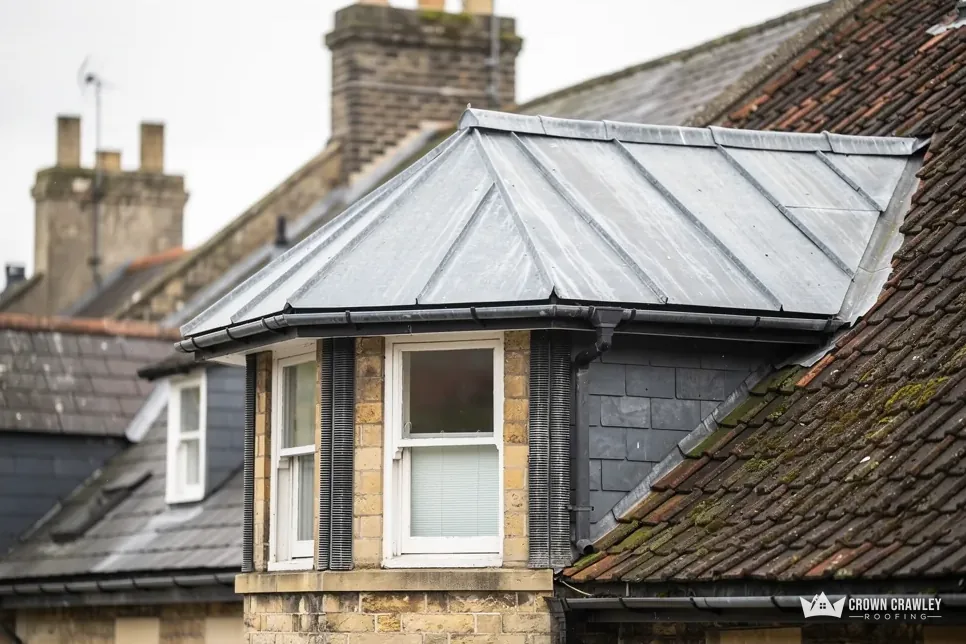
Stage 02 · Materials
Lead codes, zinc and lead-free options
Lead sheet comes in numbered codes by thickness, and each code suits certain jobs, so we choose the code first.
Lead sheet is sold by code, and the code is simply a number for the thickness. A higher number means a thicker, heavier sheet. Royston Lead's cast-lead brochure lists six codes: Code 3 at 1.32 mm, Code 4 at 1.80 mm, Code 5 at 2.24 mm, Code 6 at 2.65 mm, Code 7 at 3.15 mm and Code 8 at 3.55 mm, each with its own colour stripe from green up to orange. The same brochure shows where each is used. Code 3 is recommended for soakers only. Code 4 appears for soakers, flashings, pitched valley gutters and dormers. Codes 5 and 6 are listed for flashings, valley gutters, parapet and box gutters and dormers, and Codes 7 and 8 for valley gutters, parapet and box gutters and dormers. Our guide to lead sheet codes goes through the table in full, and a short note on which code suits a flashing sits beside it.
Lead words
- Lead code
- Number marking the thickness of lead sheet
- Soaker
- Small lead piece beneath each tile
- Flashing
- Lead strip sealing a roof to a wall
- Back gutter
- Lead channel behind a chimney stack
- Bossing
- Shaping lead by hand with mallets
Which code should a chimney flashing use?
That depends on the detail, the exposure and what the existing lead is made of. Checkatrade quotes its stepped flashing price in Code 5, which gives a sense of what is common. We look at the old lead, measure its thickness where we can, and tell you which code we plan to use before the price is final. A thicker code can suit a long run in an exposed spot, while a short, sheltered flashing may not need it. Mixing codes on one roof is normal: a heavier sheet in a valley, a lighter one in the soakers that sit under the tiles. What matters is that each piece is thick enough for the water it carries and the weather it faces, and that the pieces are tied together so no seam is left open.
Reading the old lead is part of the survey. Lead that has been on a roof for a long time turns a dull grey and grows a pale crust, which is normal and not a sign of a fault. The signs we look for are different: thin patches where the sheet has worn, splits along the folds, and edges that no longer follow the wall. A flashing that looks tired from the ground may turn out to be sound, and one that looks fine can hide a split behind the stack, so we look closely before we say which it is.
A thicker code costs more, but a thin one in the wrong place can cost more still.
How long does lead last, and what about zinc?
MyJobQuote gives lead flashing a possible life of over 80 years. VM Zinc, a zinc manufacturer and so an interested party, says a Building Research Establishment environmental product declaration gives zinc 100 years. Neither figure is a promise. How long a flashing really lasts depends on the fixings, the pointing that holds it in the wall and whether anyone has walked on it or leaned a ladder against it.
On lead-free flashing, the sensible approach is to compare like with like. Some alternatives are lighter and some are quicker to fit, but few can be shaped as freely as lead around a stepped brick stack. If you would like a lead-free quote alongside a lead one, tell us at the survey. Our lead-free flashing against lead guide sets out the trade-offs without a sales pitch.
- Code 3 to 8the numbered range of lead sheet
- Over 80 yearslead flashing life, MyJobQuote, 2026
- 100 yearszinc, VM Zinc's own figure
Stage 03 · Junctions
Chimney flashing repair and step flashing
A chimney is the most common place for a roof to leak, and the lead around its base is the first thing we check.
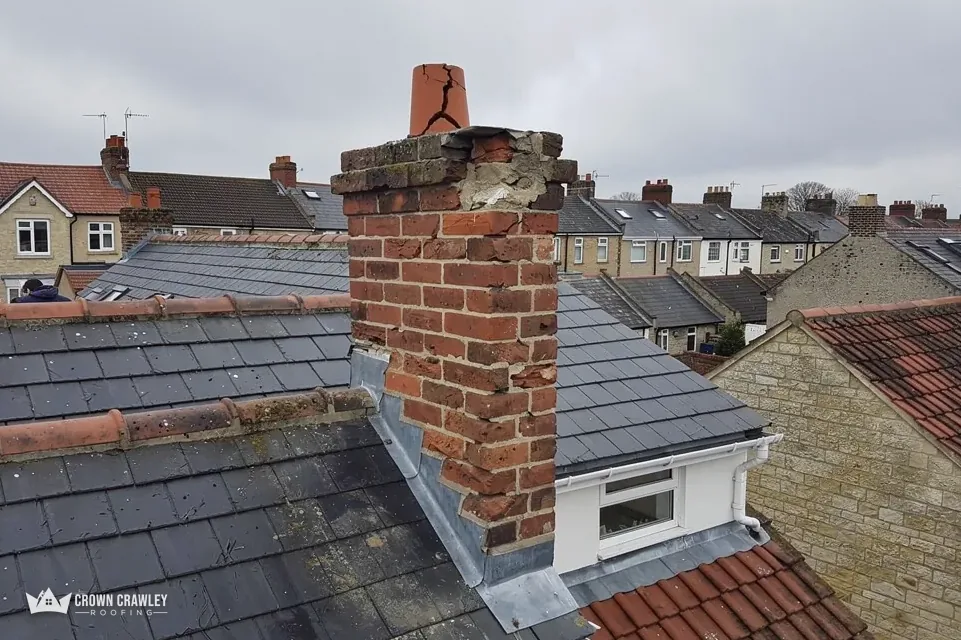
Stand under a chimney and you can read the leak risk from the base. The stack rises through the slope, so the roof has to be sealed on all four sides of it. The front is covered by an apron, a sheet of lead dressed over the tiles below. The sides are stepped: a strip of lead is folded in a staircase to follow the brick courses, with a small soaker under each tile alongside it. Behind the stack, where the roof slope rises towards it, a back gutter catches water and sends it round the sides. Chimney flashing repair, Crawley and surrounding villages alike, usually comes down to one of these four parts.
Lead flashing Crawley chimneys lose: why does it lift?
The lead is not glued to the wall. Its top edge is tucked into a groove cut into the brickwork and held with small lead wedges, then pointed over with mortar. When that mortar dries out and drops away, the lead loses its grip and the edge can lift in the wind. Frost and a past sealant fix can both make it worse. A flashing that has simply loosened can often be re-fixed and repointed. Repointing is enough in many cases, and we tell you at the survey when the lead itself has had its day.
Chimney lead checks
- Front apron
- Tight to the stack, edges dressed down
- Side steps
- One step per brick course, pointed in
- Soakers
- Present under every tile course
- Back gutter
- Clear, sloping away, no splits
- Pointing
- Mortar sound where lead is tucked in
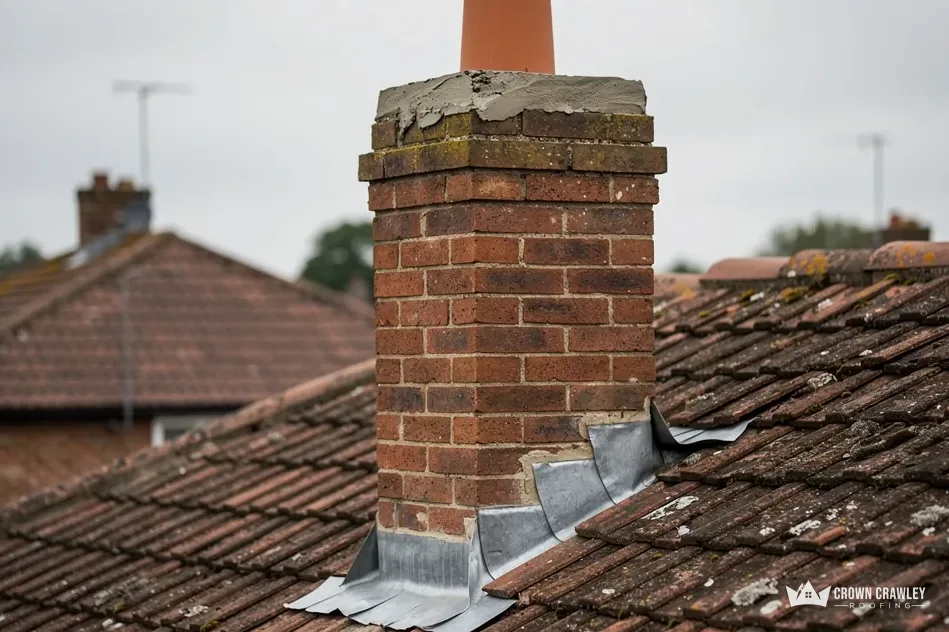
What is the difference between step flashing and cover flashing?
A step flashing climbs a sloping edge, such as the side of a chimney or the gable wall of a bungalow, in a series of stepped pieces. A cover flashing is a straight strip that hangs down over another piece of lead or over a roof below it, as it does where an extension roof meets a house wall. Both have to be tucked into the brickwork, and both are fitted with the soakers beneath. We compare the two in step flashing against cover flashing.
Do we also repair the stack itself?
Yes, where the stack is the cause. Crumbling pointing, a cracked cement cap, called flaunching, around the pots, or leaning brickwork can all let water in beside a perfectly good flashing. Fixing only the lead in that case would leave the leak in place, so we survey the whole stack and tell you what we find, with photos. Bigger stack work is covered on our chimney repairs page, and we can do the flashing at the same visit. The written price covers whichever of the two jobs you choose to go ahead with.
On a repair like this we pay attention to what is around the lead as well. A new flashing is only as good as the mortar joint it is tucked into, so the groove in the brickwork is cleaned out and checked before anything is fixed, and the tiles beside the stack are looked over for cracks.
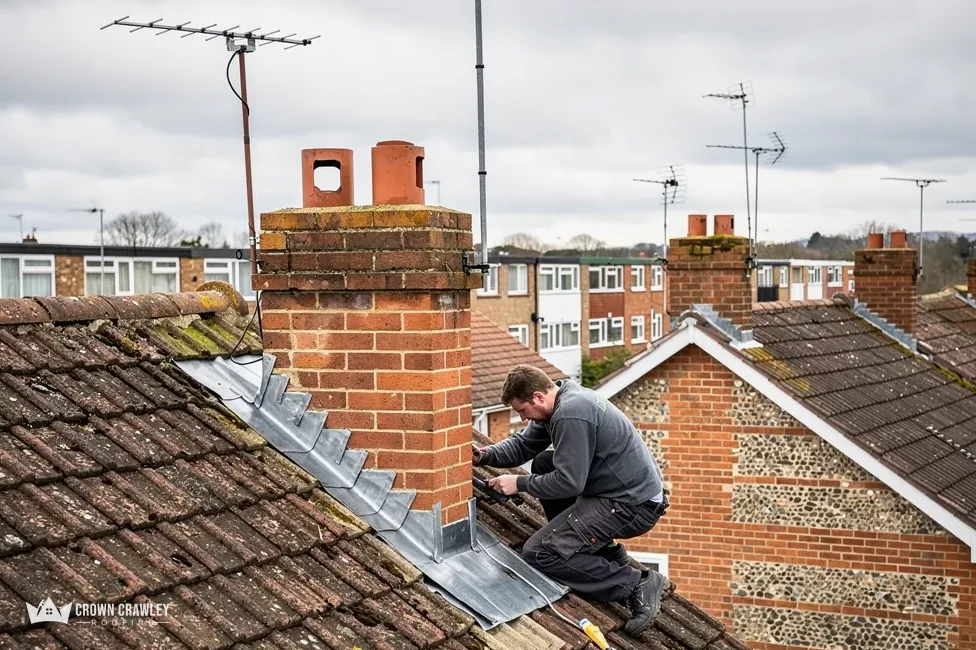
Stage 04 · Valleys and bays
Lead valley replacement, bays and dormers
Valleys, bay tops and dormers carry more water than a flashing does, so a failed detail can soak a ceiling quickly.
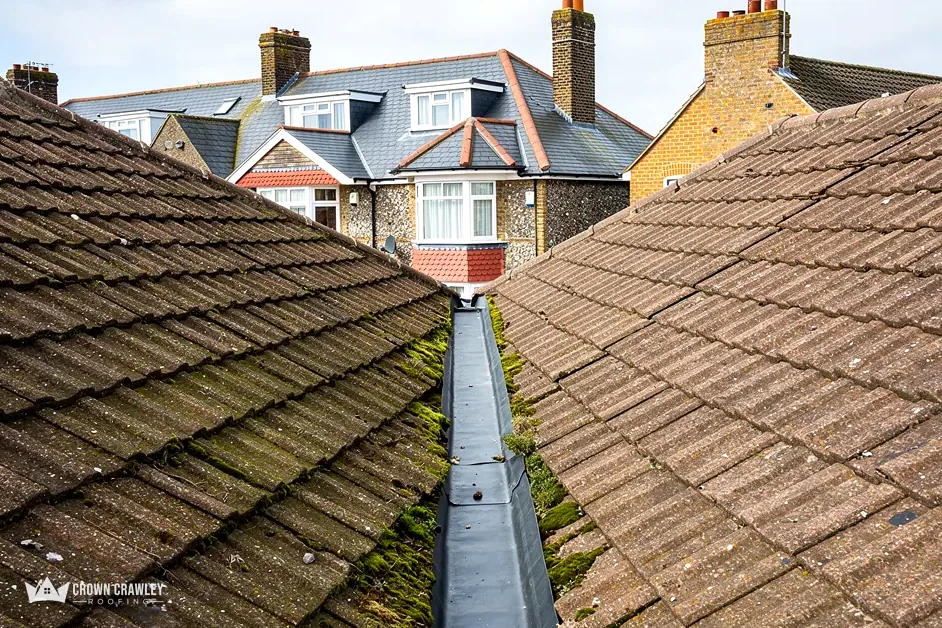
A valley is the angle where two slopes meet in a dip, and it takes the run-off from both. A lead-lined valley is a shallow gutter hidden between the tiles, and a lead valley replacement in Crawley means taking that gutter back to its boards and laying a new one. Royston Lead's brochure lists Codes 4 to 8 for pitched valley gutters and a heavier range of Codes 5 to 8 for parapet, box and tapered valley gutters, which are the deeper channels found between larger roof areas. Our guide to lead valley lifespan, leaks and replacement shows how the signs differ from a flashing.
What to look at
- Lead valley gutter
- Bay window roof
- Dormer cheek
- Roll along a flat top
Lead valley replacement Crawley: how is it done?
We strip the tiles along both sides of the valley, lift the old lead and check the boards and timbers below, because a valley that has leaked for a while can soften the wood under it. Where the boards are sound, new underlay and new lead are laid in lengths with the joints overlapped to shed water the right way, then the tiles are cut back in and fixed. Where the boards are rotten, those are replaced first. This is why a valley price is set after the survey and not over the phone, and why we say in writing what we will do if the timber turns out to be worse than it looks. A valley also needs to be clear of moss and leaves before and after the work, since a blocked channel can overflow under the tiles, and we leave the finished valley running clear from top to bottom.
Can a bay or porch roof be re-leaded?
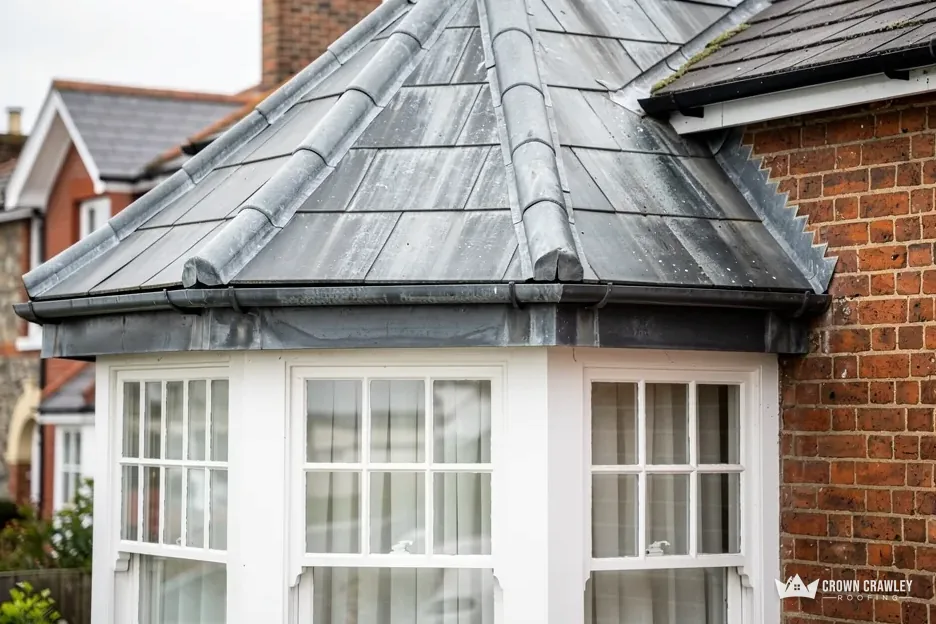
Bay windows and front porches often have a small flat or low-pitched top finished in lead, with rolls and drips to guide the water and a flashing where it meets the main wall. When these wear out, the symptom is damp on the ceiling inside the bay. Re-leading means lifting the old sheet, checking the boards and laying the new lead in short runs so that it has room to move. See our guide to lead bay window and porch roofs for what to expect.
Keep reading
What about dormer cheeks?
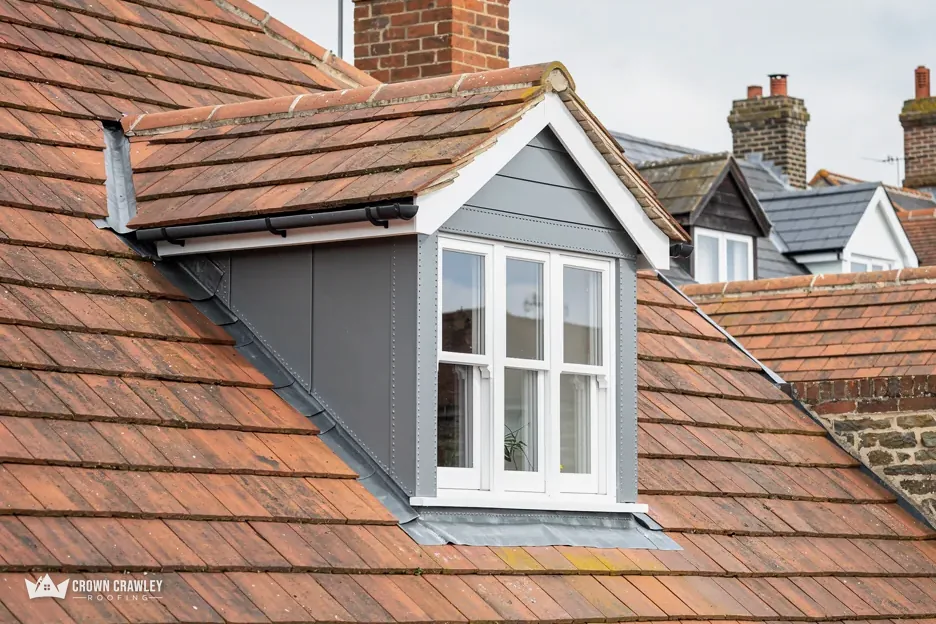
The cheeks are the side walls of a dormer, and they are often hung in lead and tucked in at the edges of the tiles. A dormer has more joints than any other part of a house, so the lead is detailed carefully at each corner, with the cheeks turned onto the roof and under the window sill. The same lead may also be where a leak starts if the tiles above it have slipped, so we look at both. If you have a leak under a dormer, our dormer cheek guide lists what we check.
Small lead flat roofs deserve a word. A canopy over a front door or the top of a roof lantern can be done well in lead, with rolls running with the fall and drips at each step, though larger areas are normally cheaper in other coverings. The sheet is laid over boards that slope gently to an edge, and the rolls and drips are positioned so that water always has a way off. We check that fall at the survey, because a flat top that holds water will fail again, whatever it is covered in.
Stage 05 · Pricing
What fails in old lead, and cost
Old leadwork fails in a handful of recognisable ways, and the price depends on reach, length of run, code and what sits behind.
Most failed lead announces itself. You may see a strip of metal standing proud of the brickwork, a seam that has opened along a fold, or a patch where lead has disappeared altogether. Inside, the usual sign is a brown ring on the ceiling beside a chimney breast, bay or dormer that appears after heavy or wind-driven rain. Missing lead after a theft or storm is the most urgent case: we make the roof safe first, and tell you what the repair will involve.
What are typical prices for lead flashing?
Checkatrade's roof repair table, dated June 2026 and excluding VAT, gives £50 to £70 per metre for lead flashing repair and £80 to £120 a metre when the flashing is stepped and cut from Code 5. MyJobQuote, last updated on 22 September 2026, gives £350 to £460 for chimney leadwork without scaffold and £700 to £920 with it. Checkatrade's chimney repair table, dated April 2026, puts a chimney flashing at £250 to £1,000. Treat all of these as national guides, not our rates. Your own quote is a single written total that follows our survey.
Cost drivers for lead
- Reach
- Ladder, tower or full scaffold
- Length
- One flashing or a whole elevation
- Lead code
- Thicker sheet costs more
- Findings
- Boards or pointing behind the lead
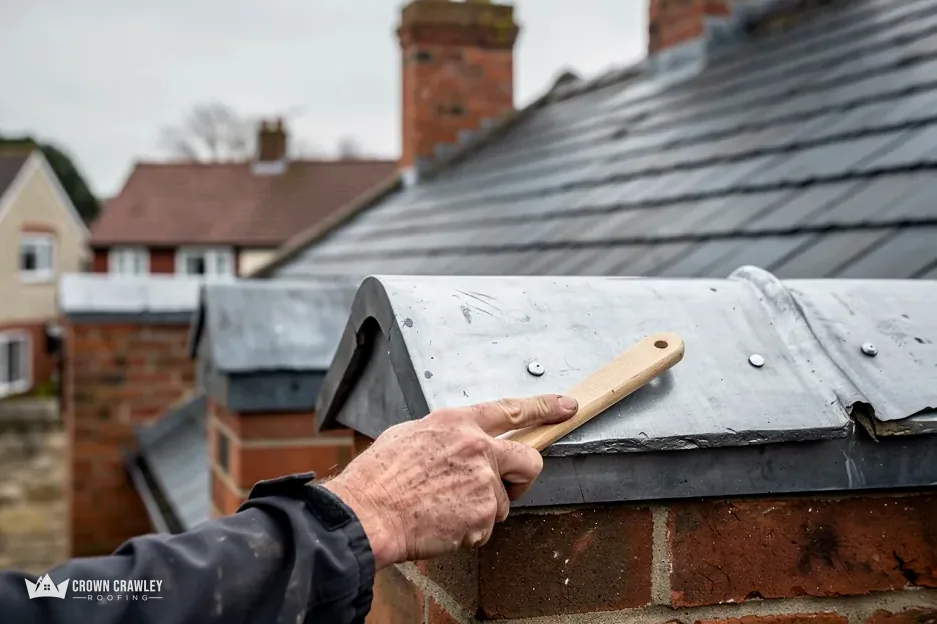
Why does the scaffold figure matter?
A chimney is usually at the top of the house, and a safe repair means a stable platform rather than a ladder leaning on the roof. MyJobQuote's chimney leadwork guide gives £700 to £920 with scaffold, against £350 to £460 without. If the scaffold stands on the pavement, the highway authority must license it: West Sussex County Council lists £266 for one month. Ask the scaffolder who applies, and we deal with the paperwork alongside them. Ask any roofer whether the price you are given includes scaffolding and VAT.
Is it cheaper to patch lead or replace it?
A short split in an otherwise sound flashing can be repaired for far less than a full replacement. When lead has thinned along the whole detail, though, patch after patch adds up, and each one leaves more seams to fail. We tell you which case you have, and say so in the written price, so that your choice rests on the evidence. If we are already on the roof for tiles, a ridge or a chimney, the lead can often be done at the same visit, which saves setting up access twice.
The lead is rarely the biggest cost. Getting safely to it usually is.
Once the cause is known, we explain the work in plain terms before you decide: which parts of the lead come off, what goes back, and what is left alone. You see the same photos we do, and you can send them to a second roofer if you want another view, since a fair price should stand up to a second look.
When you set quotes side by side, check that each covers the same flashings or valleys, names the lead code, renews the pointing, and says whether scaffold and VAT are in. A low figure that leaves out the pointing can cost you twice, because the new lead then sits in the same crumbling groove that let the old one go.
- £50 to £70per metre, lead flashing repair
- £80 to £120per metre, stepped flashing, Code 5
- £350 to £460chimney leadwork, no scaffold
Stage 06 · Sign-off
Listed buildings, permissions and sign-off
Like-for-like lead repairs seldom need permission, but older and listed houses have extra rules, and every job ends with a check below.
Replacing worn lead with new lead of the same kind in the same place is the simplest sort of roof job. Planning law does not count work as development when the outside of the building still looks materially the same afterwards, so a like-for-like flashing normally needs no planning permission. Changing a detail so that it looks different, such as swapping a lead roll for another covering, is a different matter, and the rules differ for flats and for buildings in conservation areas. Before you choose a new look, ask the council's planning team. For Crawley that means Crawley Borough Council.
Can lead on a listed building be repaired?
Yes, but with care. A listed building needs listed building consent before anyone alters it in a way that changes its special character, and the South Downs National Park Authority says that "regular maintenance and minor 'like for like' in-situ repairs do not need listed building consent". Where the line falls on a particular house is a question for the council's conservation officer, so check before work starts, and tell us at the survey if the house is listed.
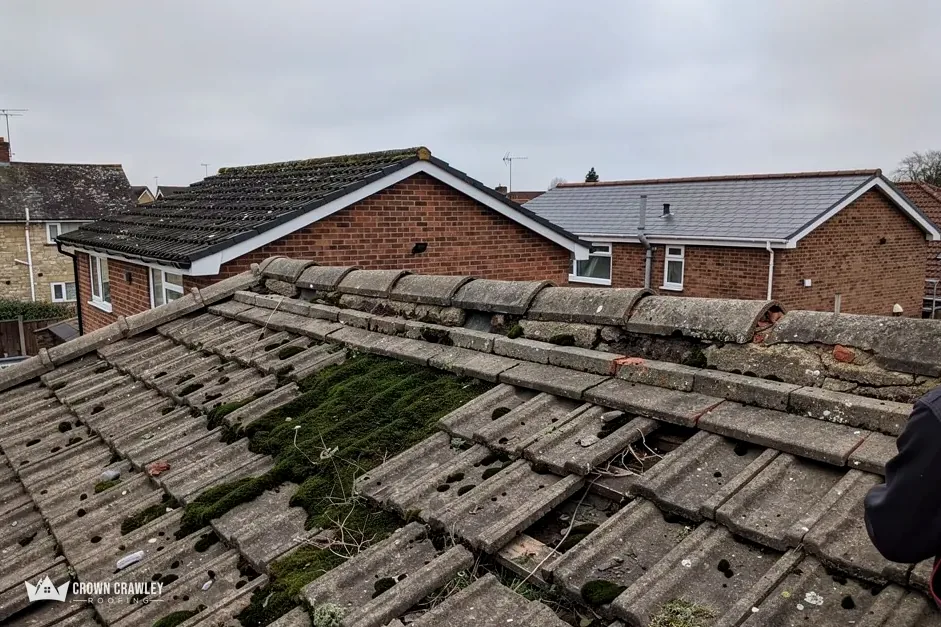
Do we do labour-only leadwork for builders?
Builders working on an extension or a new bay can send us the drawings and tell us which flashings or valleys they need, the lead code they have specified and how we reach the roof, and we price the leadwork as a single total. The same questions apply as for a householder: access, length of run and what is behind the lead, and we answer them in the written total so the main contractor can plan the week.
What happens when lead has been stolen?
Tell your insurer first, take photos of the roof and keep receipts for any temporary repair. We can make the roof weathertight with a temporary cover, and then quote for new lead in a proper code and fixings. Whether a claim pays out is the insurer's decision, and if you are unhappy with it, the Financial Ombudsman Service handles complaints.
Permission words
- Like for like
- Same material, same look, same detail
- Listed building
- Entered on the national heritage register
- Conservation area
- Area where character is protected
- Listed building consent
- Approval for works altering a listed building
On completion we check the junction from the roof and from the room below for damp, clear any mortar or offcuts from the gutter and send you the after photos next to the survey ones. If we find a nest or bat droppings under the lead, we stop and speak to you first, because government advice on bats lists roof work among the activities that can disturb them. To start, send a photo of the junction taken from the pavement or garden, plus a note of the room where the stain appears. Then we know which lead to inspect first.
Typical UK prices for lead work
| Work | Guide price |
|---|---|
| Lead flashing repair | £50 to £70 per metre |
| Stepped flashing (Code 5) | £80 to £120 per metre |
| Chimney flashing repair | £250 to £1,000 |
| Chimney leadwork, no scaffold | £350 to £460 |
| Chimney leadwork, with scaffold | £700 to £920 |
Figures like these are guides from national sources, never our rates. Our price for your roof is a single sum in writing, set after the survey and its photos.
Checkatrade roof repair table, June 2026 (per metre figures, excluding VAT); Checkatrade chimney repair table, April 2026; MyJobQuote chimney leadwork guide, last updated 22 September 2026.
Lead work guides and answers
Longer guides and short answers on lead codes, flashings, valleys, bays and dormers, for anyone weighing up a repair.
Guides and posts
Lead Sheet Codes Explained: Code 3 to Code 8A lead code is a number that tells you how thick and heavy a sheet is. This guide sets out codes 3 to 8 and the parts…Guide · 8 min read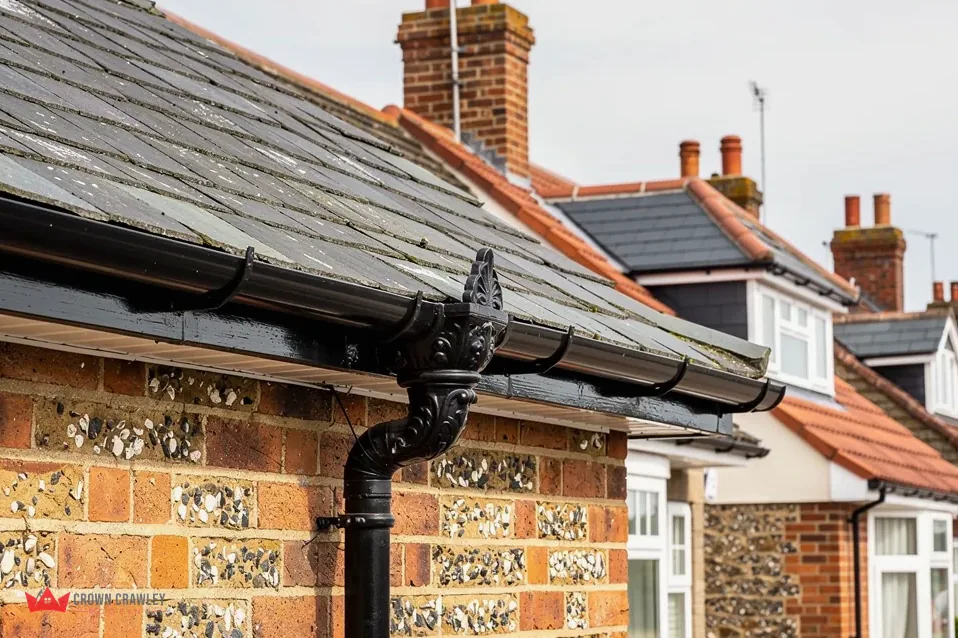 Step Flashing vs Cover FlashingStep flashing, cover flashing, soakers and aprons all seal the place where a roof meets a wall. This guide explains…Guide · 9 min read
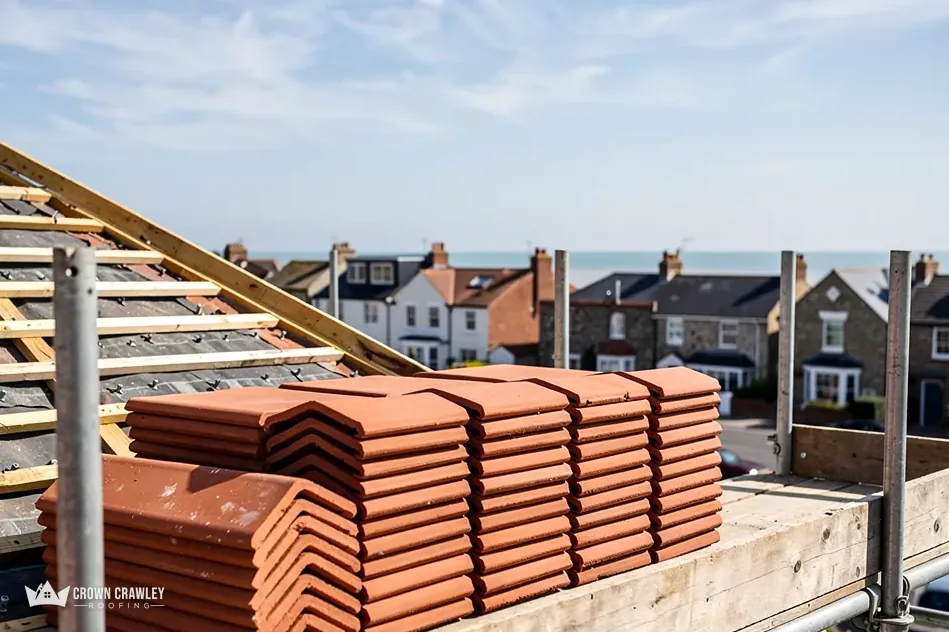 Lead-Free Flashing vs Lead: An Honest ComparisonLead-free flashing products promise less temptation for thieves and a lighter price tag. This guide weighs them…Guide · 9 min read
 Lead Bay Window and Porch RoofsBay and porch roofs cover little area yet carry a crowd of folds, edges and wall junctions. This guide explains why…Guide · 9 min read
 Lead Valleys: Lifespan, Leaks and ReplacementA lead valley hides in the angle between two roof slopes and does a lot of work. This guide covers its lifespan, the…Guide · 9 min read
 Lead Stolen From Your Roof: What to DoFinding the lead gone from a chimney or valley is a shock, and the leak that follows can cost more than the metal.…Guide · 9 min read
 Lead Dormer Cheeks and Dormer FlashingsThe side walls of a dormer, called cheeks, are covered in lead on many houses. Most dormer leaks start where those…Guide · 9 min read
 Small Lead Flat Roofs and CanopiesLead can cover a small flat roof or canopy for generations when it is laid with the right falls and joints. This…Guide · 9 min read
 Maintaining Your Lead Roof: Tips for Longevity and Weather ResistanceLead asks little of you, but it does want a look once a year. Here is what to check on a bay, porch or flashing, and…Blog · 9 min read
 Lead Roofing Repairs: Common Problems and How They Are FixedLead is among the longest-lasting roof materials, so when it fails the cause is usually the detail around it. Here…Blog · 9 min read
 Lead Roofing: Timeless Looks and Lasting DurabilityLead has covered roofs for centuries and is still the first choice for bays, porches and awkward junctions. Here is…Blog · 9 min read
 The Art of Installing Lead Roofing: Techniques and ConsiderationsLead is laid by hand, sheet by sheet, and the details decide whether it lasts or splits. Here is how a lead job is…Blog · 9 min read
Quick answers
- How Long Does Lead Flashing Last?
- What Code of Lead Is Used for Flashing?
- Can Lead Flashing Be Repaired?
- How Much Does Lead Flashing Replacement Cost?
- Why Does Lead Flashing Crack?
- Lead Flashing Coming Away From the Wall
- What Is the White Residue on Lead Flashing?
- Why Is Lead Staining My Roof Tiles?
- Is Lead Flashing Dangerous?
- Lead Roof Repairs on a Listed Building
- Lead Welding vs Bossing: What Is the Difference?
- What Are Lead Soakers?
- What Is a Lead Apron Flashing?
- Can You Paint Lead Flashing?
- Lead Flashing Where an Extension Roof Meets the Wall
- What Are Drips and Rolls on a Lead Roof?
- Repointing Lead Flashing: When and How
- How Much Does a Lead Roof Cost per m2?
- Zinc vs Lead Roofing
- How Is Lead Flashing Fixed to a Roof?
Related services
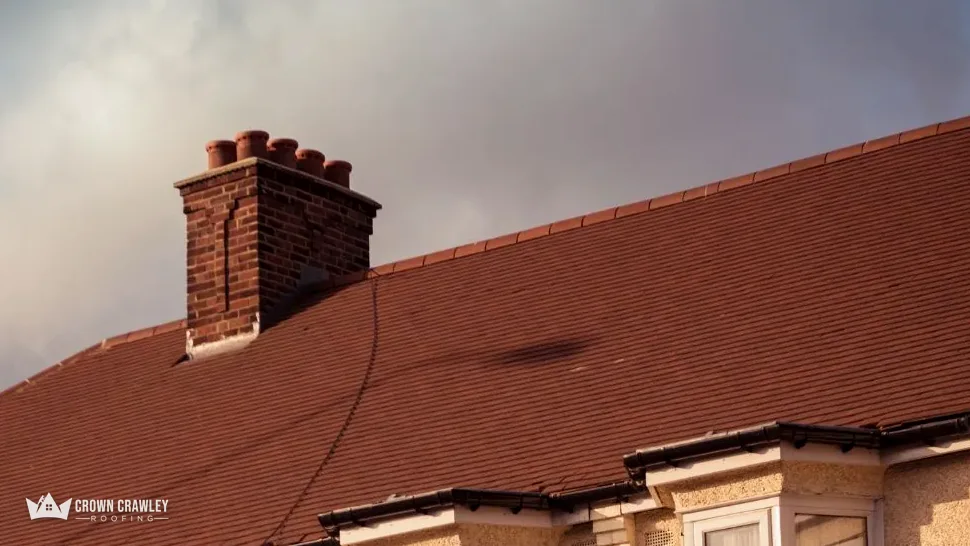 Chimney repairsWe repair chimney stacks across Crawley and the towns around it: crumbling mortar, cracked flaunching, failed lead…
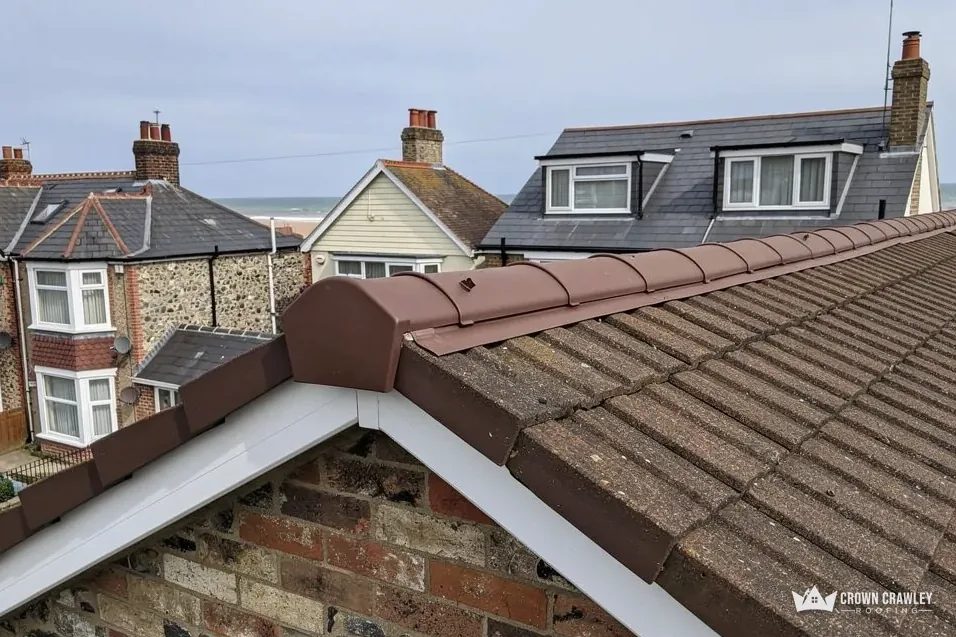 Pitched roofingOur pitched roofing service covers tiled and slate roofs across Crawley and Sussex: slipped tiles, tired battens…
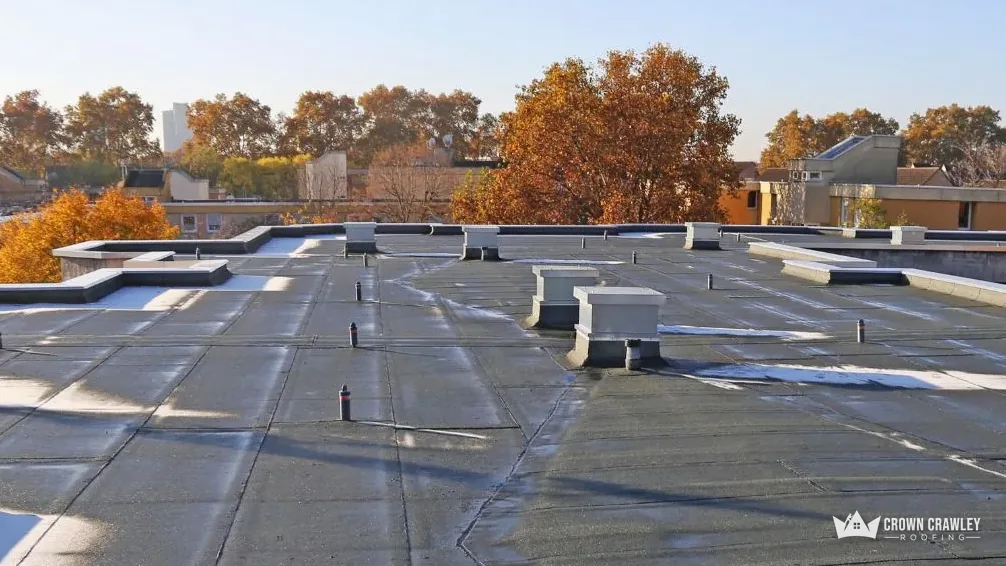 Flat roofingOur flat roofing service covers garage, extension, dormer and balcony roofs in Crawley and the towns around it: GRP…
Lead work questions
Can a lead flashing be repaired, or must it be replaced?
A flashing that has only loosened, or whose pointing has fallen out, can often be re-fixed and repointed. One that is split, thinned or torn along its length is better replaced, because patches leave extra seams. We photograph the lead at the survey, say which case yours is, and put the answer in the written price, so nothing is a surprise on the day.
What thickness of lead goes on a chimney?
Royston Lead's brochure lists Code 4 for flashings, and Codes 5 and 6 as well. Checkatrade quotes its stepped flashing price in Code 5. The right choice depends on the exposure and the length of the run, so we name the code in your written price instead of guessing from the ground, and we explain why we chose it.
Is lead-free flashing as good as lead?
It depends on the detail. Lead can be shaped around a stepped brick stack by hand, which few alternatives match. Zinc has a published 100 years from its maker, against over 80 for lead flashing. Neither number is a promise, and the fixings count for as much as the metal does. Tell us at the survey if you want an alternative priced next to lead.
What should I do if lead has gone missing from my roof?
Tell your insurer first, photograph the gap and keep receipts for anything you pay to stop water getting in. We make the roof weathertight and then quote for new lead. Whether the insurer pays rests with that insurer, and the Financial Ombudsman Service handles complaints about it, and we can give you dated photos of the damage, so keep every email, letter and photo.
Do builders get a separate leadwork quote?
Builders can send drawings, the lead code specified and details of access, and we price the leadwork element as one total. If the specification is open, we suggest a code at the survey. Site access and the stage of the build can change the price, so tell us when the roof will be ready.
Why has my ceiling stained beside the chimney but nowhere else?
Rain tends to enter at one of the stack's four sides, or through cracked pointing or flaunching on top. The stain shows where water finally escapes, not where it entered. We trace it from the loft and the roof, and photograph the point of entry so you can see for yourself where the fault sits.
Show us the junction that worries you
Photograph the chimney, wall or valley from the garden and note where the damp shows inside; that tells us which lead to inspect first.