
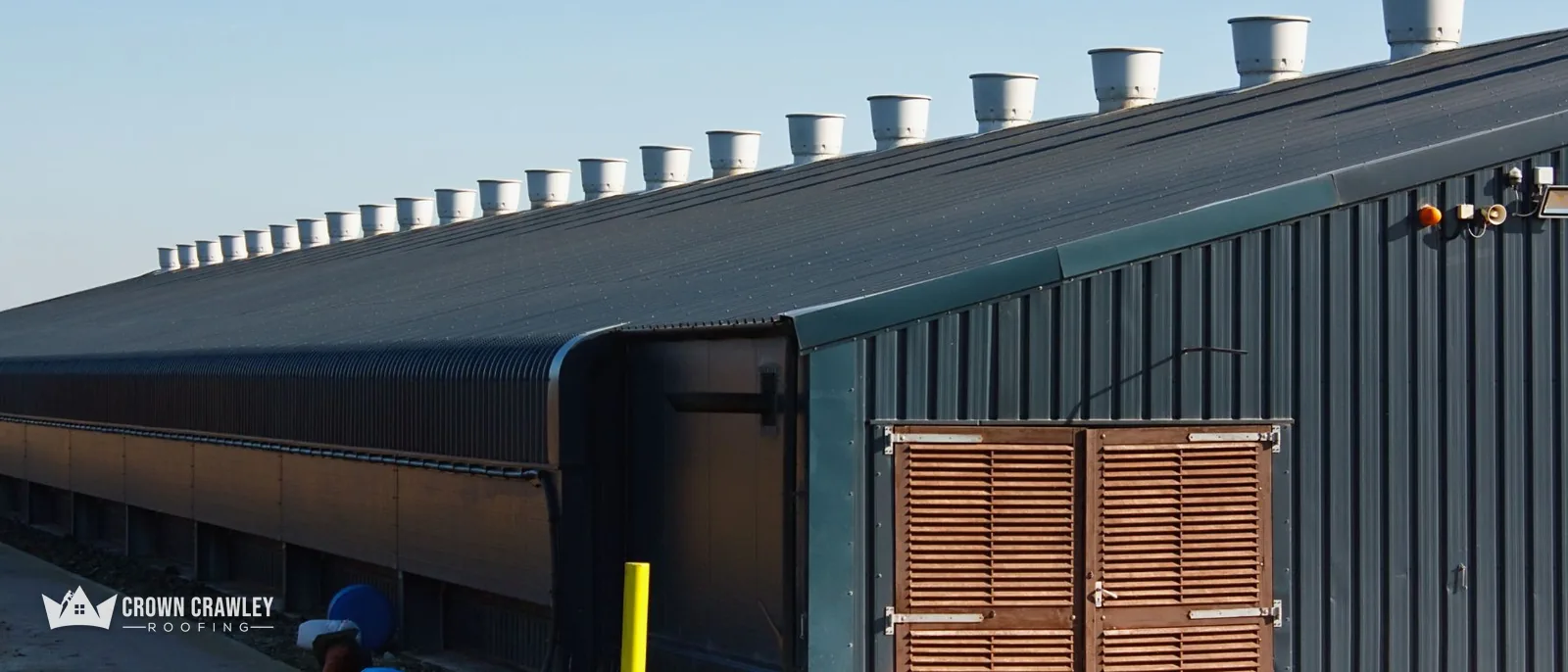

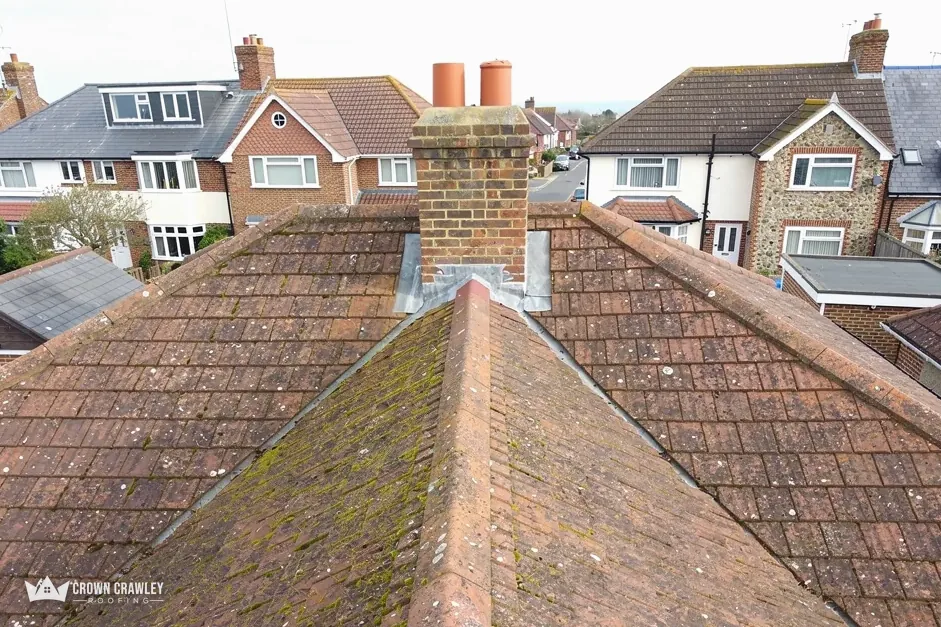
 Cut Edge Corrosion on Metal RoofsRust that starts along the cut edge of a coated steel sheet looks minor and spreads quietly. This guide explains why…Guide · 9 min read
Commercial Roofing in Crawley & Gatwick
Roof repairs, flat roofs and cladding for working buildings.
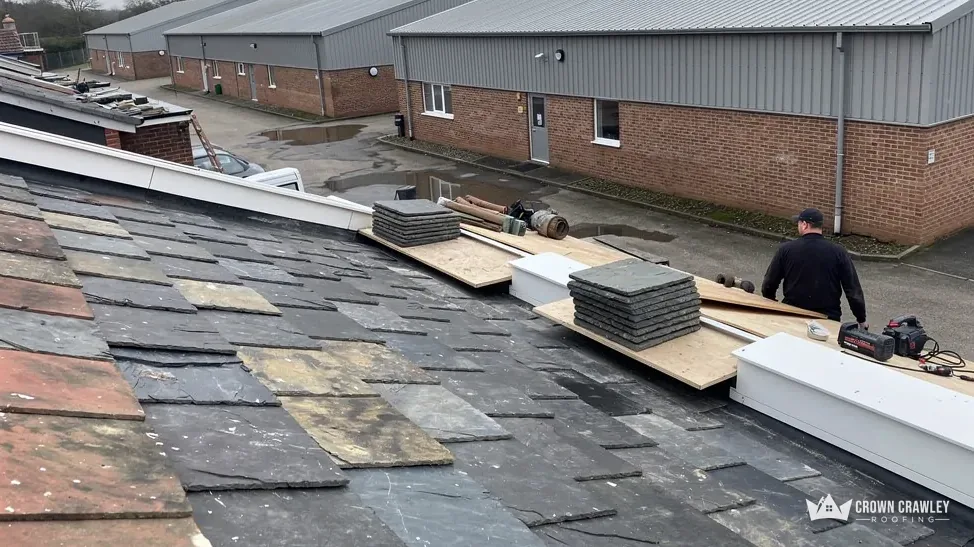
Commercial roofing for Crawley, Gatwick and the rest of Sussex: repairs, refurbishment and new roofs on warehouses, units, shops and garage blocks. We survey first, send you photographs and put one total in writing.
- Survey photos of your own roof
- One written price
- Repairs, re-roofs and emergencies
- Tidy site, waste taken away
Signs your commercial roof needs attention
- Stained ceiling tiles or buckets on the floor
- Daylight through sheets or around roof lights
- Ponding water long after the rain has stopped
- Rust streaks running down from sheet edges
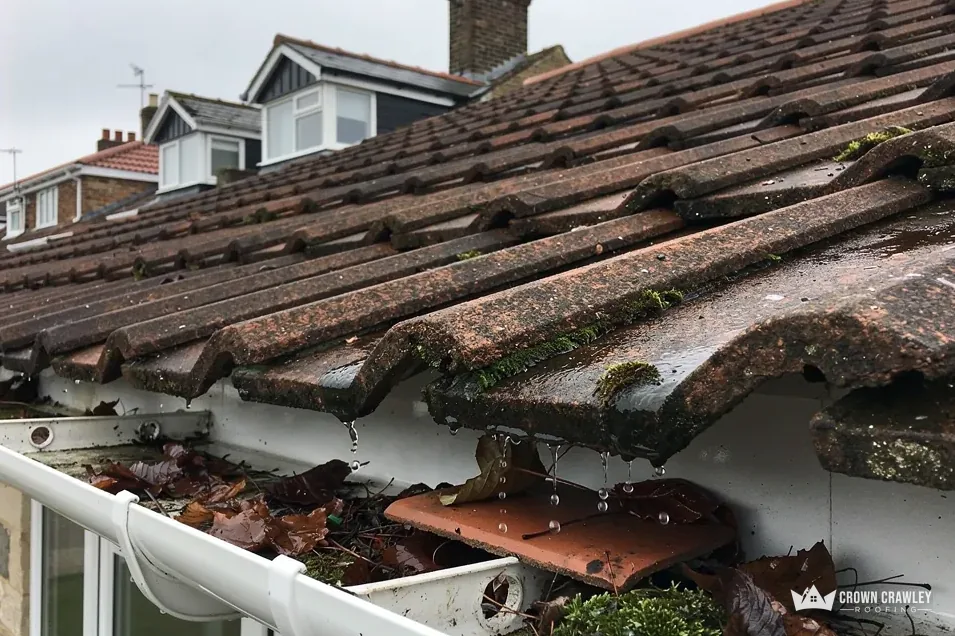
- Gutters overflowing above the loading bay
What our commercial roofing service covers
 Commercial roof repairsLeaks traced to the sheet lap, outlet or upstand that is really failing, then repaired and photographed before we leave site.
 Flat roof systemsEPDM, GRP, built-up felt and liquid-applied coatings laid to a fall, with upstands and outlets detailed to suit the building.
 Sheeting and claddingProfiled metal, fibre cement and insulated panels replaced or overclad, with wall cladding and trims matched to the roof.
 Roof lightsWorn or yellowed roof lights replaced, and the kerbs, fixings and sheets around them checked while the roof is open.
 Box gutters and drainageValley and box gutters cleaned, relined or replaced, with outlets and downpipes cleared so water leaves the roof freely.
 Surveys and maintenanceCondition surveys with photographs, and planned visits that clear drainage and catch small faults before they stop work.
Repair, refurbish or replace?
- RepairThe faults are local, the covering around them is sound, and patching costs less than renewing.
- RefurbishThe structure is sound but the weather skin is tired, so it is recoated or overclad.
- ReplaceThe covering, insulation or deck has failed widely, and repairs would only chase the next leak.
How a commercial roof job runs
- 1Tell us about the buildingYou send the address, the roof type if you know it, and where water shows inside.
- 2A survey with photographsWe reach the roof safely, record each fault as we find it and photograph it for you.
- 3A single total in writingThe price arrives as one figure, with the photographs, the cause and the programme we propose.
- 4Work, check and reportWe work around your trading hours, check the drainage and send the after photographs.
The commercial roof diary
Inside a commercial roof job
Six stages of a commercial roofing job around Crawley and Gatwick, from the first look at the unit to the final drainage check.
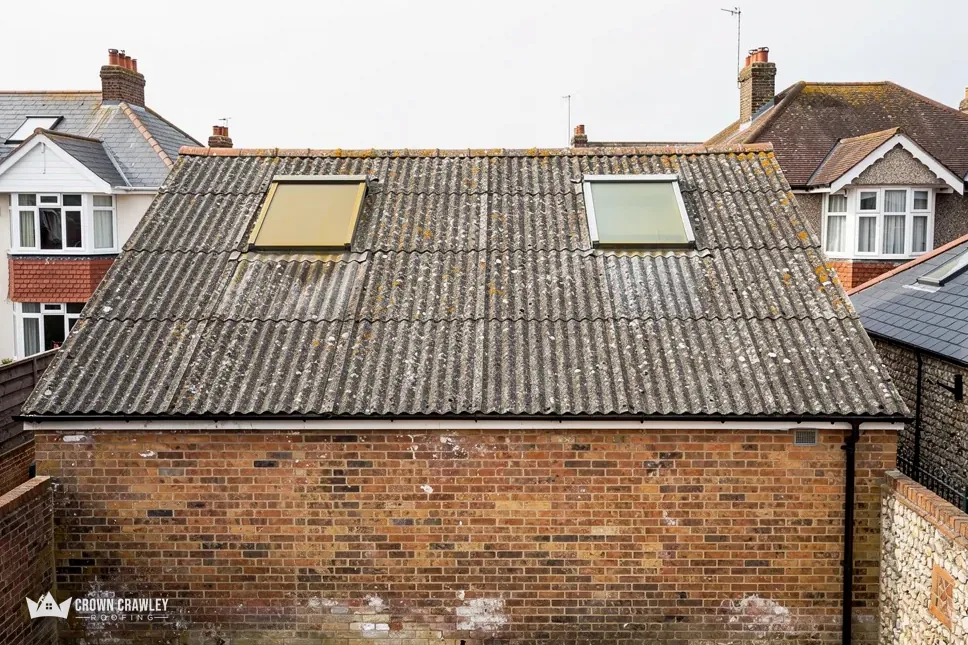
Stage 01 · First look
Commercial roofing services across Crawley and Sussex
Commercial roofing covers repairs, refurbishment and new roofs on buildings that earn their keep, so the work has to fit around the people inside.
Commercial roofing is the repair, refurbishment and renewal of roofs on buildings used for business: warehouses, workshops, factory units, shops, offices, garage blocks and the flat roofs over rear extensions. Our commercial roofing, Crawley first and Sussex wide, runs in Crawley, around Gatwick and through West Sussex, Surrey and the borders with East Sussex and Kent. A roof over a working building has to keep stock dry and staff at their jobs, so the survey comes first and the price comes last.
Who looks for commercial roofers in Crawley?
Several kinds of customer call us. The owner of a unit wants a leak stopped without losing trading days. A landlord or managing agent wants a clear account of the roof before choosing between repair and renewal. A tenant with a repairing lease wants to know which faults are theirs. A shop owner, or the manager of a block of garages, has a flat roof that is small but matters a great deal. Each of them gets the same sequence from our commercial roofers, Crawley and Gatwick included: a look at the roof, photographs of what we find and one total price in writing. Our answer on who pays for commercial roof repairs under a lease goes further into the question of responsibility.
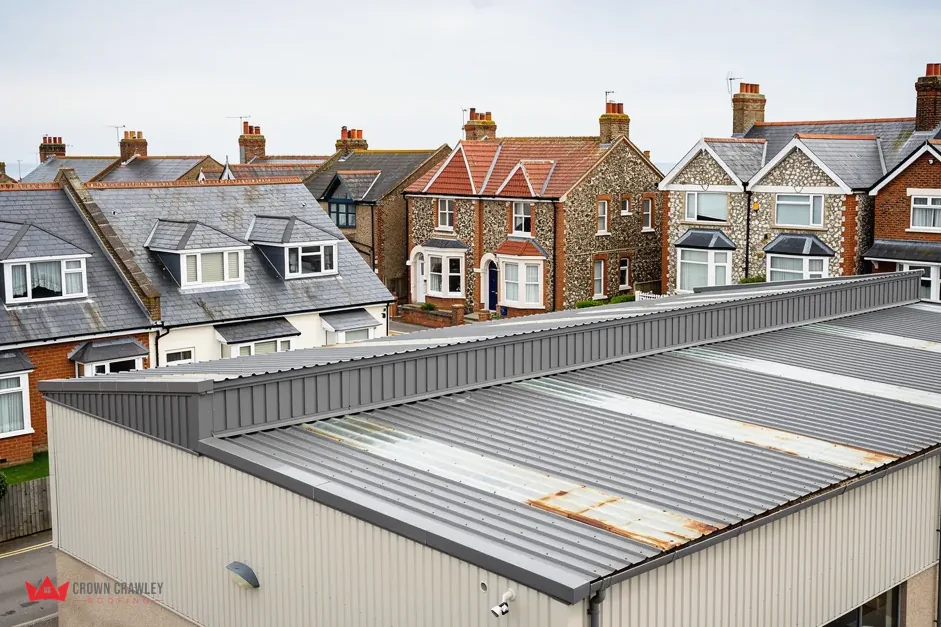
- Sheet lap and fixings
- Roof light edge
- Box gutter outlet
- Parapet upstand
What is the difference between a roof repair and a new roof?
Commercial roof repairs Crawley owners ask about deal with a fault: a lifted lap in a sheet, a split in a membrane, a blocked outlet, a failed upstand or a cracked roof light. Refurbishment keeps the structure and renews the weather skin over it, for example by overcladding old sheets or recoating a flat roof. A new roof strips the covering, and often the insulation, and rebuilds it. The honest answer on which one you need comes from the survey and not from a sales call. A repair is the better buy whenever the covering around the fault is still sound. When a repair would only chase the next leak across a tired roof, we explain why.
What does a first visit to a unit involve?
We ask where water shows inside and when, then we reach the roof, or look from a tower or platform where the surface is fragile, and trace the leak from the outside in. Water on a large roof can travel a long way along a lining or a purlin before it drips, so the stain on the floor is a clue and not a verdict. We photograph the laps, fixings, outlets, upstands, roof lights and gutters, then send you the pictures with a plain account of the cause. Our guide to commercial roof condition surveys explains what a fuller written report contains.
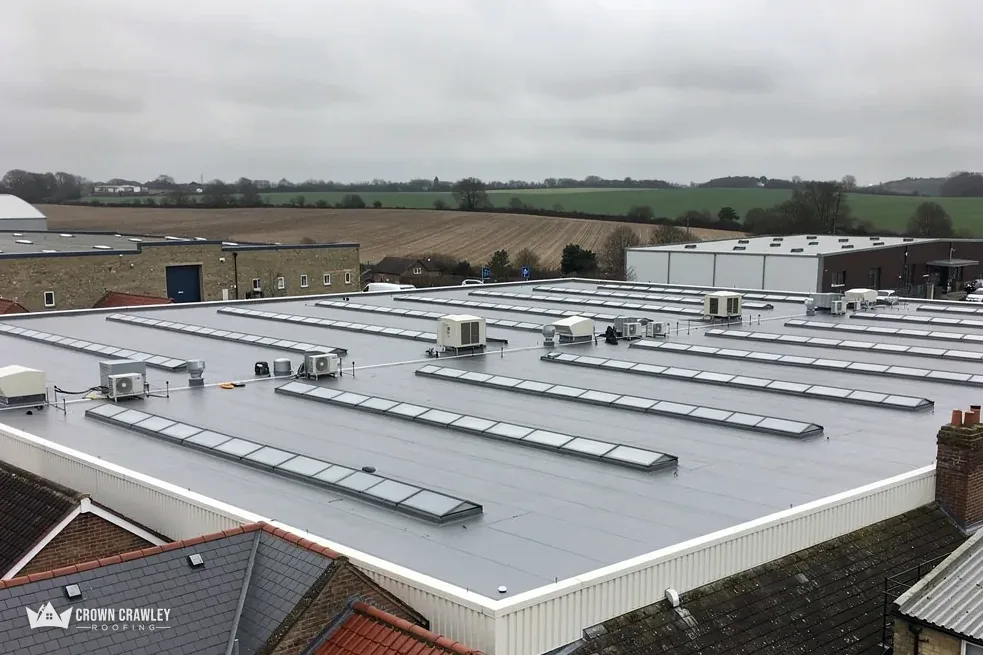
Stage 02 · Systems
Flat, liquid and single-ply roof systems
A flat roof on a commercial building can wear EPDM, GRP, felt or a liquid coating, and each one ages and repairs differently.
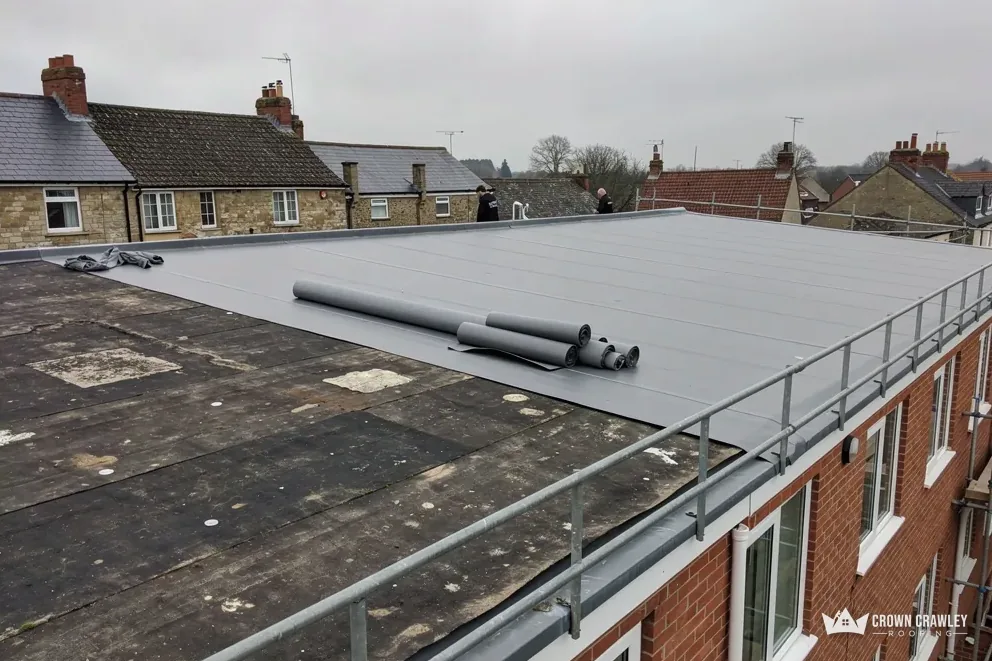
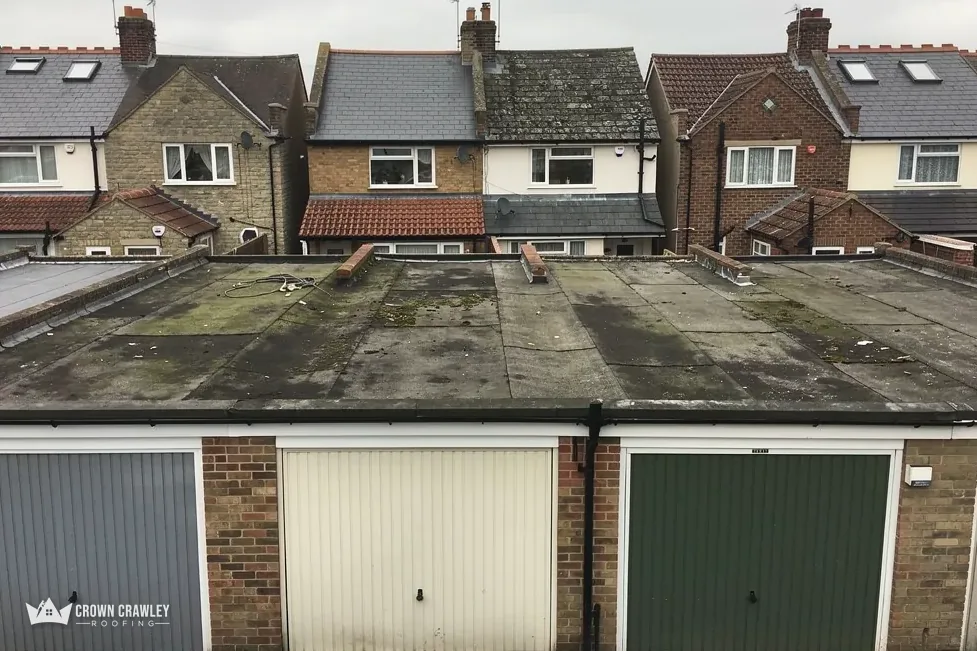
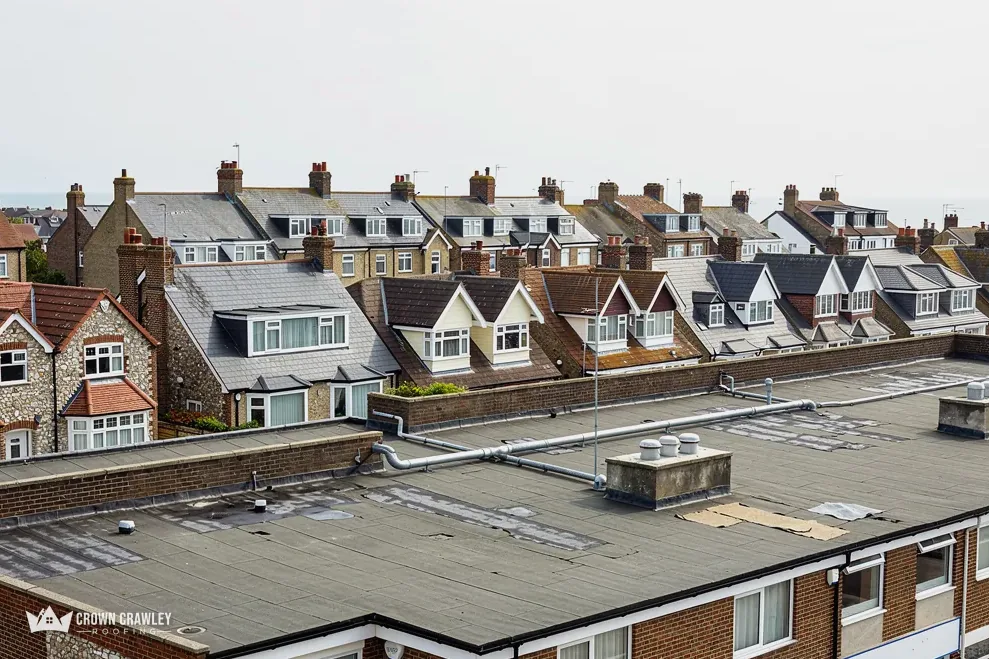
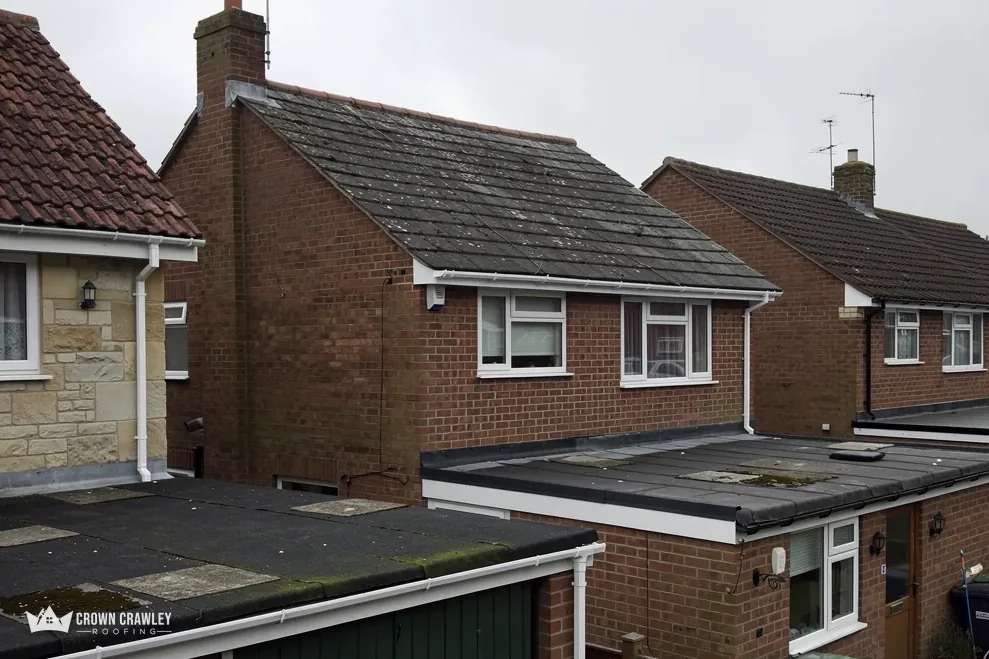
Shops, rear extensions, garage blocks, the lean-to roofs on workshops and the canopies over loading doors carry flat roofs. They are really gently sloping roofs whose covering is one continuous waterproof layer laid over a deck and its insulation. Whether the job is flat roof commercial Crawley work on a single unit or a row of garages, the first question is the same: what is on the roof now, and what lies under it? Our flat roofing page covers the same systems for homes, and the points below apply to larger and busier buildings.
Flat roof words
- EPDM
- Synthetic rubber sheet laid over the deck
- GRP
- Resin and glass fibre set in place
- Single-ply
- One factory-made membrane, joined at seams
- Upstand
- Raised edge where a roof meets a wall
- Fall
- Slope that sends water to the outlets
- Box gutter
- Lined channel between two roof slopes
Which flat roof system suits a commercial building?
Single-ply membranes, EPDM among them, arrive as factory-made sheet that is laid over the deck and insulation and joined at the seams, so there are fewer joints to make on site. GRP is resin and glass fibre laid wet and cured in place, which suits awkward shapes and small areas with many pipes through them. Built-up and torch-on felt is laid in layers and has a long record on larger areas, while liquid-applied coatings are rolled or sprayed onto a sound existing surface to renew it. GreenSpec gives EPDM an expected service life of 20 to 30 years, and the Less cost guide, last updated March 2026, puts GRP at 25 to 40 years and felt at 10 to 20. These are typical ranges, not promises. Our guide to single-ply roofing membranes explains how the sheets are joined and where they fail.
How should a commercial flat roof drain?
Water that sits on a roof ages the covering and finds every weakness in it. BS 6229:2025, the current code of practice for flat roofs with continuously supported flexible waterproof coverings, keeps a minimum 1:80 finished fall for general roof areas and internal gutters. IKO, citing the 2018 edition, says the roof should be designed for a fall of 1:40. Pools that linger long after rain point to a shortfall in the falls, a sagging deck or a blocked outlet. Before recommending a new membrane we check the outlets, box gutters and upstands, because a membrane laid over a drainage fault fails early.
A warranty is a promise about cover. It is not a forecast of how long the roof lasts.
Should the old layer be recoated, covered or stripped?
Where the existing layer is dry and firmly stuck down, a new membrane or coating can sometimes go over it. Where the insulation beneath has taken in water, a new layer only traps the damp. We open a few test cuts and photograph what is inside, so the choice rests on evidence. Manufacturers' warranties attach to the system and to the way it is laid, and a warranty is not a lifespan, so ask any contractor what a warranty needs from you, such as keeping the drains clear.
Penetrations decide how long a flat roof stays watertight. Every pipe, vent, roof light kerb, solar bracket and air-handling unit is a hole in the covering or a weight on it, and each needs an upstand or collar made to suit the membrane. Before a refurbishment we list them all, because plant fitted later by other trades can leave rough cuts and unsealed fixings. Where equipment has to move so the covering beneath it can be renewed, we agree the sequence with your site manager so that the plant ends up back on a sound roof.
- 20 to 30 yearsEPDM service life (GreenSpec)
- 25 to 40 yearsGRP, Less guide, March 2026
- 10 to 20 yearsFelt, Less guide, March 2026
Stage 03 · Industrial
Industrial roof sheets, cladding and roof lights
Industrial roofs are built from large sheets, so faults gather at laps, fixings, roof lights and edges rather than across the open sheet.
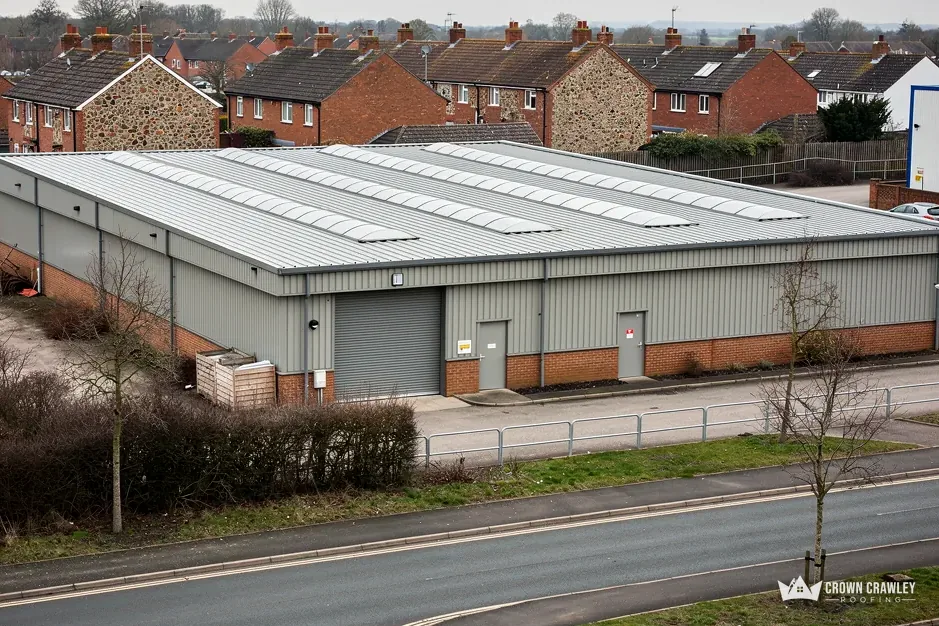
Industrial roofing, Crawley units especially, means large sheeted roofs on warehouses, distribution units and workshops: profiled metal, fibre cement or insulated composite panels fixed to purlins on a steel or concrete frame, with roof lights let in to bring daylight to the floor below. Cladding is the same family of products used on the walls. Because a sheeted roof has so many joints and fixings, we survey it joint by joint, and the photographs show you exactly where each fault sits.
What goes wrong on a sheeted industrial roof?
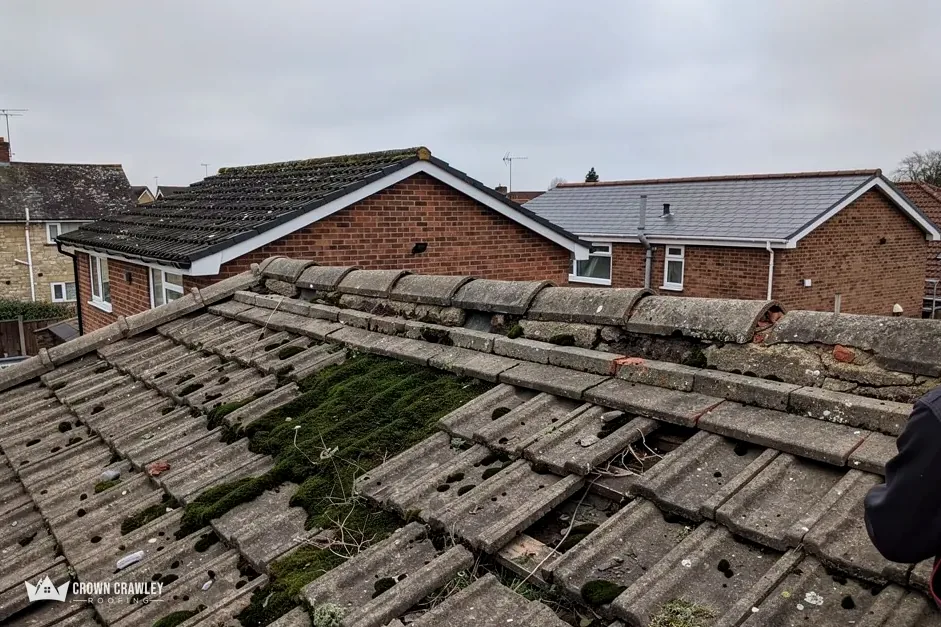
Fixings loosen and corrode, laps open where sheets have moved, and a sheet gets holed when other trades fit plant or walk across it. Rust shows first along cut edges and around fixings, and a stain running down from a sheet edge is worth a closer look. Gutters between bays fill with leaves, moss and debris, then overflow into the building. Roof lights can crack or fail at their fixings, so we treat every one as fragile until we have proved otherwise. Our guide to overcladding an asbestos cement roof covers one specific case in more depth.
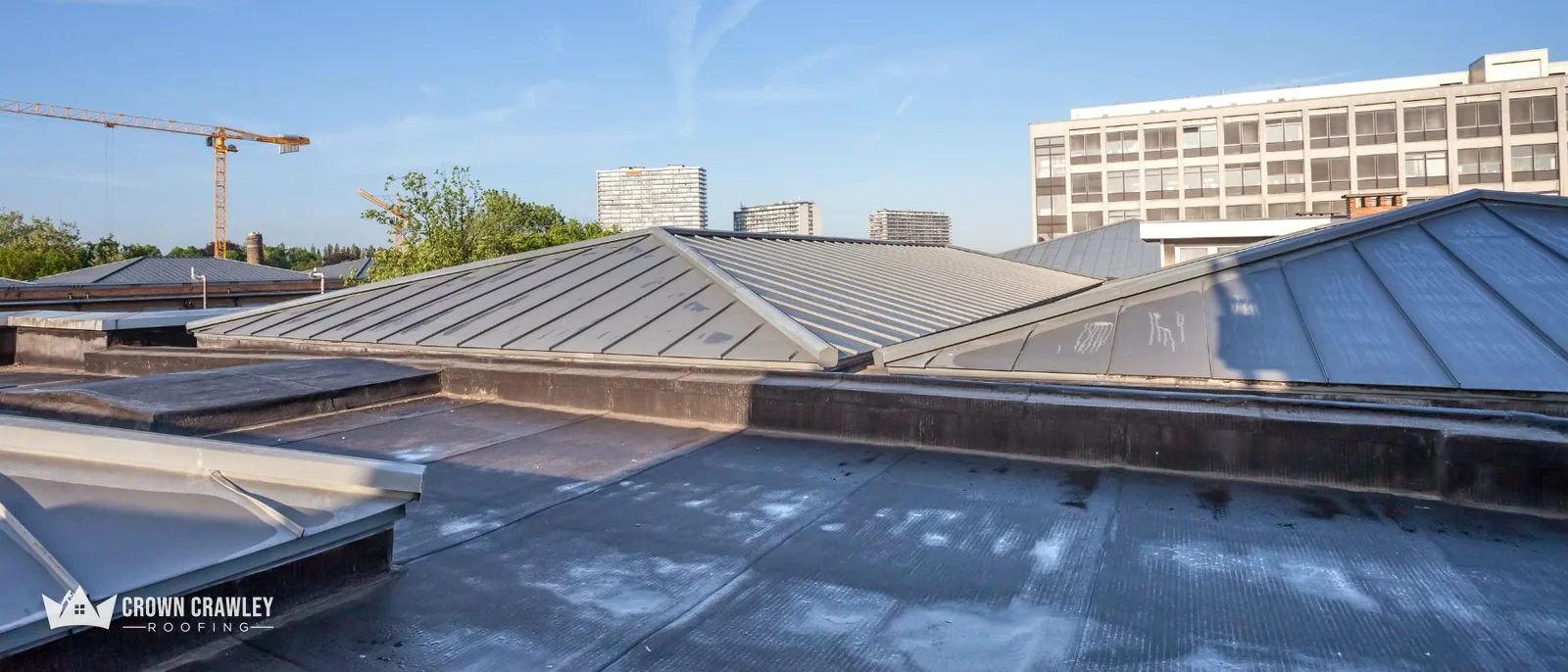
Sheet roof checks
- Laps
- Sealed, tight and free of gaps
- Fixings
- Present, tight and not corroded
- Roof lights
- Sound, unbroken and safely guarded
- Gutters
- Clear outlets and sound joints
- Edges
- Flashings and trims fixed firmly
Can an old roof be overclad instead of stripped?
Overcladding fixes a new sheeted layer above the existing one, usually on new supports. It can save time and keep the building dry during the work, but it adds weight, and the structure has to carry it. Approved Document A treats a significant change in roof loading as an increase of more than 15%, and the Planning Portal advises asking a structural engineer or surveyor to confirm the position before work that changes the weight of a covering. We ask for any drawings you hold, look at the purlins and rafters from inside, and say plainly if a stripped roof is the safer course.
What should an owner know about asbestos cement sheets?
HSE says: "If the building was built or refurbished before 2000, assume that there is asbestos in it." HSE guidance also says that asbestos cement roofs are always fragile. Its page on non-licensed work lists asbestos cement products, such as roof sheeting, provided the material is carefully handled and removed without breaking up, and that includes asbestos cement which is weathered but not otherwise substantially damaged. If the material starts to break up and create significant dust, the work becomes notifiable non-licensed work. Asbestos waste is double-wrapped and labelled. So an asbestos survey comes before any price for an older roof, work is planned from the start to keep weight off the sheets, and the route is agreed with you in writing before anyone steps on the roof.
Stage 04 · Aftercare
Surveys, maintenance and commercial roof repairs
A written condition survey lets a landlord or facilities manager plan spending, and planned visits catch small faults before they stop work.
Many commercial roof leaks are not a surprise to anyone who has looked at the roof recently. The sheets were loose, the outlet was clogged or the upstand had split, and nobody had been up to see. Planned attention costs less than an emergency repair on a leaking roof, and it gives a landlord or facilities manager a view of the next few years instead of a series of shocks.
What does a commercial roof condition survey cover?
A condition survey walks every roof area and records the covering, laps, fixings, upstands, outlets, gutters, roof lights, plant penetrations and edge details. Each finding is photographed and marked as urgent, due soon or worth watching, so the report can be read by someone who has never seen the roof. It also lists faults we noticed but left alone, such as a tired flashing on a neighbouring bay. If you then want work done, it is priced as one total for the scope you choose, and the photographs explain what drove it.
Is a planned maintenance visit worth arranging?
A planned visit is a walk over the roof to clear gutters, outlets and moss, check laps, fixings and roof lights, and photograph what has changed since last time. The spacing depends on the building: trees overhead, dust from the process inside, a busy yard below and the age of the covering all set it. We agree the visits with you and give one written price for the arrangement. A roof that is cleared and checked is easier to repair and to defend when a lease ends, and our note on roof replacement and new roof work explains what happens if a survey shows the roof has reached the end of its repairable life.
What happens when a leak cannot wait?
We make a leaking roof safe first. That means a temporary repair, cover or sealing that keeps water away from stock, machinery and electrics, followed by a proper survey and a written proposal for the lasting fix. If water is near electrical equipment, keep people clear and ask a qualified electrician to isolate the supply. Photograph the leak and the damage as you find them, note the date and the weather, and keep the pictures with your records. They help whoever carries out the repair, and they help you if responsibility under a lease has to be settled.
Maintenance words
- Condition survey
- Photographed record of a roof's state
- Planned visit
- Scheduled walk, clean and check
- Reactive repair
- Call-out to fix a fault that appeared
- Dilapidations
- Tenant's repair liability at lease end
- Make-safe
- Temporary step that keeps water out
The repairing clauses in the lease decide it, and landlords and tenants often read them differently. At the end of a tenancy a landlord may serve a schedule of dilapidations listing repairs they say the tenant owes. A dated condition survey taken during the term gives both sides facts to work from. We are roofers and not lawyers, so take legal advice on the clauses themselves, and use our photographs to show what the roof looked like.
Stage 05 · Local sites
Commercial projects at Manor Royal and Gatwick
Industrial units around Crawley and Gatwick share a few practical limits: shared access, tall equipment near the airport and tenants who cannot stop.
Crawley's industrial units sit close to Gatwick, and the places we work most closely with them include the units around Manor Royal. Beyond the town we reach Horley, Horsham, Burgess Hill, East Grinstead and Reigate, with a similar mix of warehouses, workshops, trade counters and shops. These sites bring their own questions before a ladder is raised: how the crew gets into the yard, who shares the roof or the gutter, and what the airport expects when equipment goes up high. Our guide to Manor Royal and Gatwick-area industrial roofs goes through the local points in more detail.
Before the crew arrives
- Access
- Yard, gate and delivery route agreed
- Cranes
- Gatwick permit checked for any high lift
- Plant
- Units and ducts located on the roof
- Neighbours
- Shared roofs and gutters identified
- Hours
- Noisy work agreed with the tenant
What changes for warehouse roof repairs, Gatwick side?
Warehouse roof repairs, Gatwick units included, need only a ladder, a tower or a platform, but any job that needs a crane or tall lifting equipment is different. Gatwick's own page says you need a permit to use a crane within 6km of the airport, with an exception if the crane or equipment is under 10m high or hidden from every side by trees or structures that are taller. Applications go in tandem with the Civil Aviation Authority application, and restrictions may cover working hours, height limits and obstacle lighting. The airport adds that operating a crane or large construction equipment within 6km of an aerodrome without a permit is an offence under the Air Navigation Order. Its Level 1 standard permit without technical assessment costs £300 plus VAT. Check how far your site is from the airport before a lift is booked, and see our guide to cranes and tall equipment near Gatwick.
How do you repair a roof on a multi-tenant estate?
Many estates have terraces of units under one long roof, shared valley gutters and a single service yard. A leak in one unit may start in the neighbour's bay, and a repair to a shared gutter affects several tenants. We trace the water, photograph where it enters and where it exits, and tell you whose bay and whose gutter are involved. Where a landlord looks after the structure, we send the survey to them as well, so the right person approves the work. Shared roofs also mean shared access, so we agree in advance which yard the materials arrive through, which gate stays clear for deliveries and where the skip stands, and we tell neighbouring units when their bay will be opened. If a gutter or flashing on the boundary needs attention, we photograph it and report it to you without touching a bay that is not part of your scope.
Near Gatwick, a roof repair starts with the access and the lift, not just the leak.
Can the roof be repaired while the unit keeps trading?
Often it can, with a plan. Our answer on roof repairs while a business is open sets out the principles. On a live site we agree the working area, the route for materials, where the crew parks and when the noisy work happens. Loud fixing can be arranged for quiet periods, and exposed areas are closed up and watertight by evening.
A programme is a dated order of work, agreed before the first day. It names the bays to be opened, the days of noisy work, the deliveries and the hours the crew is on the roof. It also says what you will see each morning and what will have been closed up by evening. Tenants cope with disruption better when they know when it ends, so we send you the programme with the price and update it if the survey photographs or the weather change the plan.
- 6 kmGatwick crane permit radius
- Under 10 mCrane height outside the permit rule
- £300 plus VATLevel 1 permit, no technical assessment
Stage 06 · Sign-off
Safe working, VAT and the written price
Roof work is work at height on a building people use, so the plan covers access, edge protection, tenants and what the price includes.
Roof work carries the risk of falls, so access and edge protection are planned before the first sheet moves. A tidy, well-run roof job also keeps your own staff and visitors clear of the work, and keeps materials from blocking fire routes, loading bays or the neighbours' yard. Everyone on a site we run is told the plan for the day, and you are told what happens each day as well.
What does safe access on a commercial roof look like?
The method follows the roof. A low flat roof over a shop may need a ladder and a tower, while a tall warehouse may call for scaffolding with edge protection, a mobile platform or a purpose-built access system. Old sheets and roof lights are treated as fragile, and access is planned so that weight stays off them. Where scaffolding stands on a public road or pavement, the highway authority's scaffold licence is needed, and it is arranged between us and the scaffolder. For West Sussex, the county council says it needs a minimum of 10 working days' advance notice from the date of application, and a one month scaffolding licence costs £266 on its published scale. Scaffolding on your own private land needs no highway licence.
Will the quote include VAT and scaffolding?
Our quote is one written total after the survey. The standard VAT rate is 20%, so ask any contractor whether the figure includes it, and whether it includes scaffolding, access equipment and waste removal. Whether VAT can be recovered is a question for your accountant. What drives the total is the roof's area, the access it needs, the covering chosen and what the survey finds under the fault. Compare totals for the same scope of work, and be wary of any figure that takes it for granted the deck is sound. Ours spells out what we will inspect once the roof is open and agrees anything extra with you first.
Site words
- Edge protection
- Guardrails that stop falls at the edge
- Fragile surface
- A surface that may not take weight
- Programme
- Dated order of work and access
- Scaffold licence
- Highway authority consent for pavement scaffolds
What do you hand over at the end?
When the work is done we check the gutters, outlets and downpipes, clear the waste and send the after photographs beside the survey ones. We list faults we noticed but left alone, such as a tired flashing or a cracked roof light on a bay we were not asked to repair, so you can plan for it. Wild birds' nests that are in use or being built are protected by law, so we look along gutters and under sheet laps before work starts, and we tell you if a nest changes the timing. To begin, send the unit's address, a note of where water shows inside and any roof plan or earlier survey you hold. That tells us where to look first on arrival.
Typical UK prices for flat roof repairs and coverings
| Work | Guide price |
|---|---|
| Bitumen roof repair | £100 to £140 per m² |
| GRP roof repair | £130 to £180 per m² |
| EPDM roof repair | £120 to £170 per m² |
| New EPDM flat roof | £80 to £100 per m² |
| New felt flat roof | £50 to £80 per m² |
These are national guide figures for the covering, not our prices. A commercial roof is priced from its own area, access and survey findings, and you receive one written total.
Checkatrade cost guides: roof repair table, June 2026 (repairs up to 3 m², excluding VAT); rubber roofing guide, September 2026.
Commercial roofing guides and answers
Guides and short answers on condition surveys, membranes, asbestos cement sheets, lease repairs and keeping a business running while the roof is repaired, for landlords, tenants and facilities managers.
Guides and posts
Cut Edge Corrosion on Metal RoofsRust that starts along the cut edge of a coated steel sheet looks minor and spreads quietly. This guide explains why…Guide · 9 min read Overcladding an Asbestos Cement RoofAn old fibre cement roof can be covered over or taken off, and each route has its own risks and costs. This guide…Guide · 9 min read
 Single-Ply Roofing Membranes ExplainedSingle-ply is a factory-made sheet laid over insulation, not a coat built up on site. This guide compares the three…Guide · 9 min read
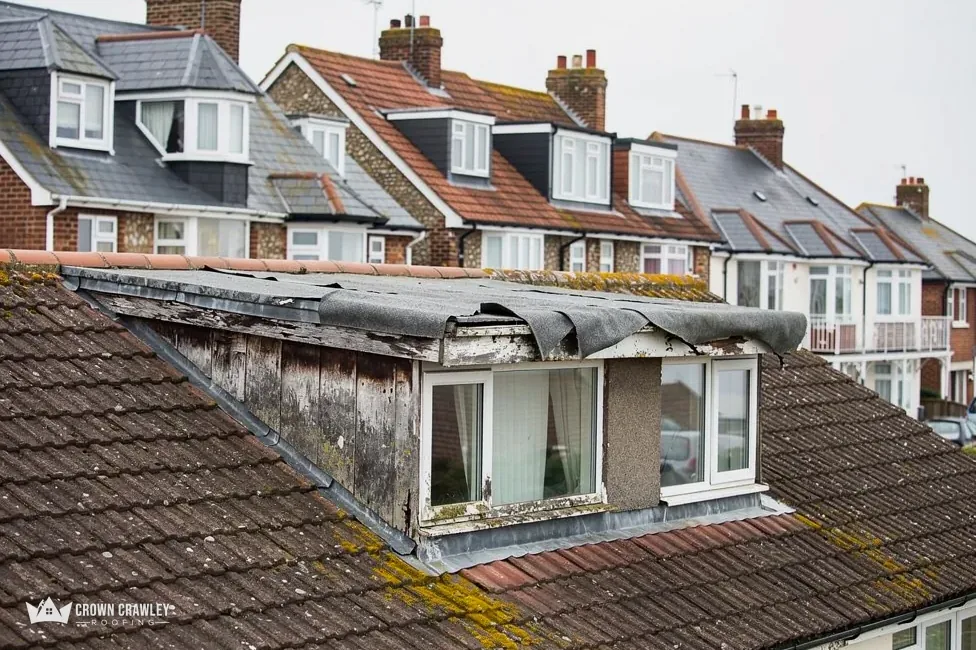 Fragile Roofs and Rooflights: Safety RulesSome roofs and rooflights look solid and give way without warning. This guide explains how to spot them, how safe…Guide · 9 min read
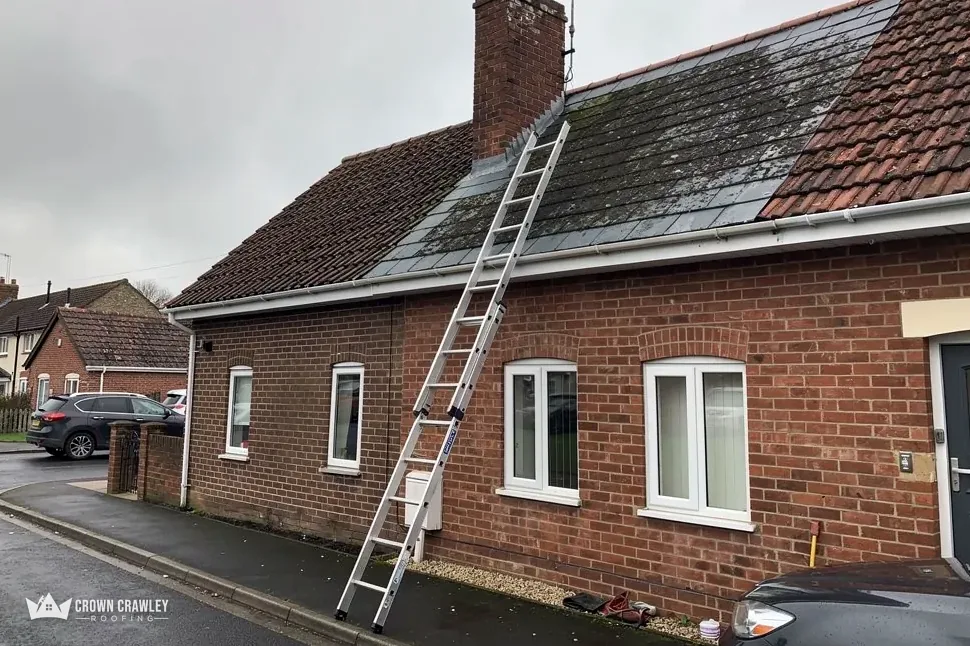 Commercial Roof Condition SurveysA condition survey tells you what state a commercial roof is really in, how long repairs can hold and what to budget.…Guide · 9 min read
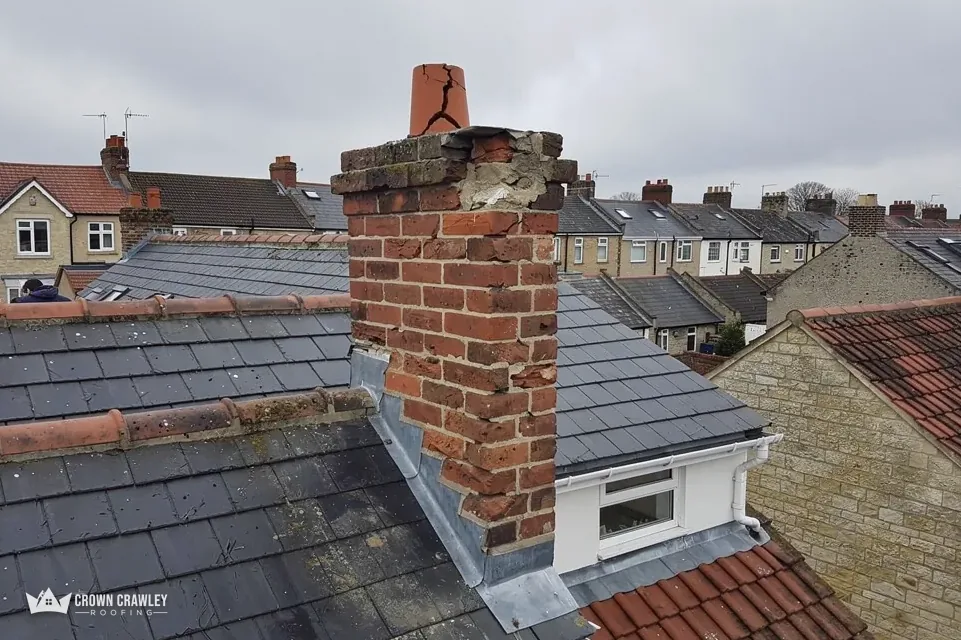 Manor Royal and Gatwick-Area Industrial RoofsIndustrial units around Gatwick share one problem: the roof has to be mended while the business below keeps running.…Guide · 9 min read
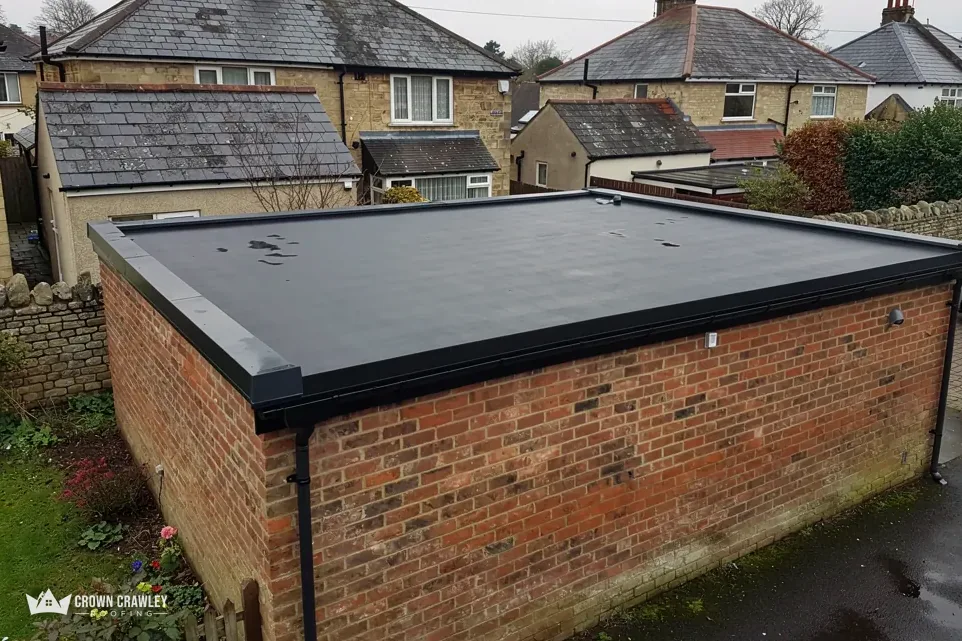 Commercial Flat Roof Warranties: What They CoverA flat roof warranty is only worth the paper if you know who signed it, what it covers and what quietly cancels it.…Guide · 9 min read
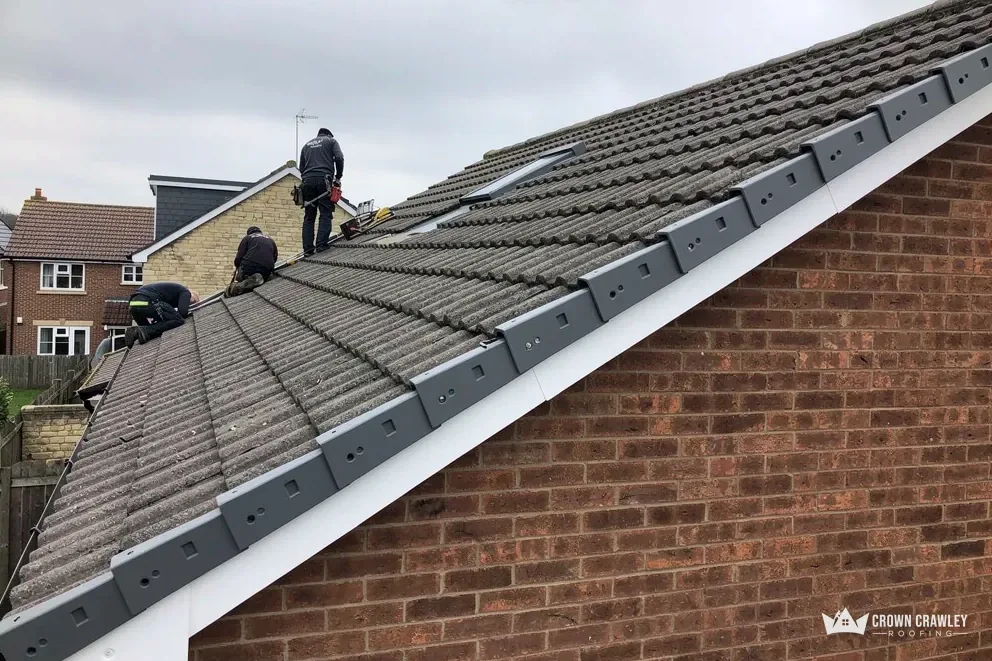 Roofing for Commercial Properties: Meeting the ChallengesA warehouse, a parade shop, an office block and a school all keep the rain out in different ways. Here is what each…Blog · 10 min read
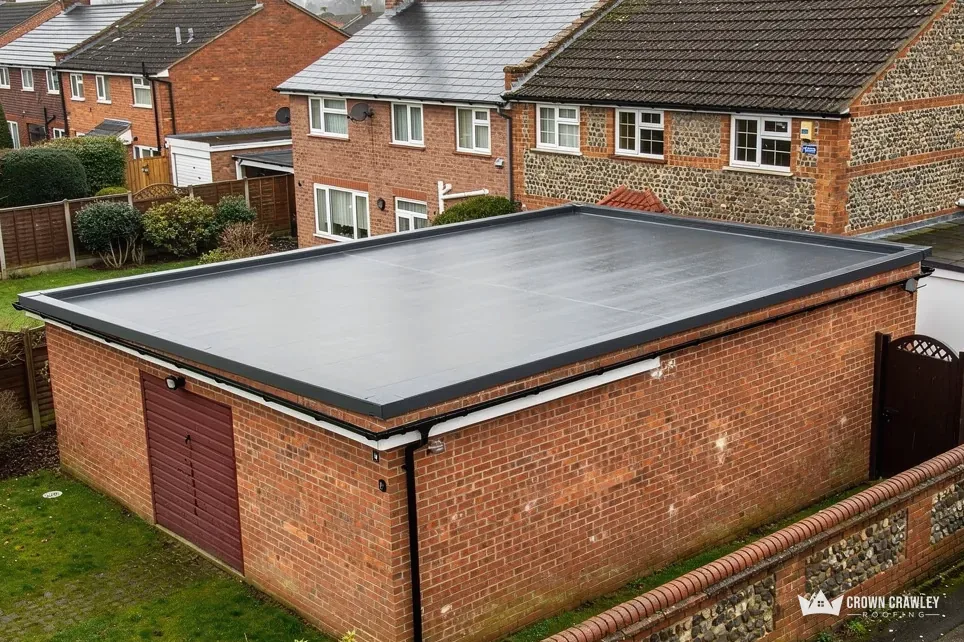 Commercial Roofing: Protecting Your Business From the Top DownA roof you never think about is the easiest kind to own, but only a plan keeps it that way. Set up inspections, a…Blog · 10 min read
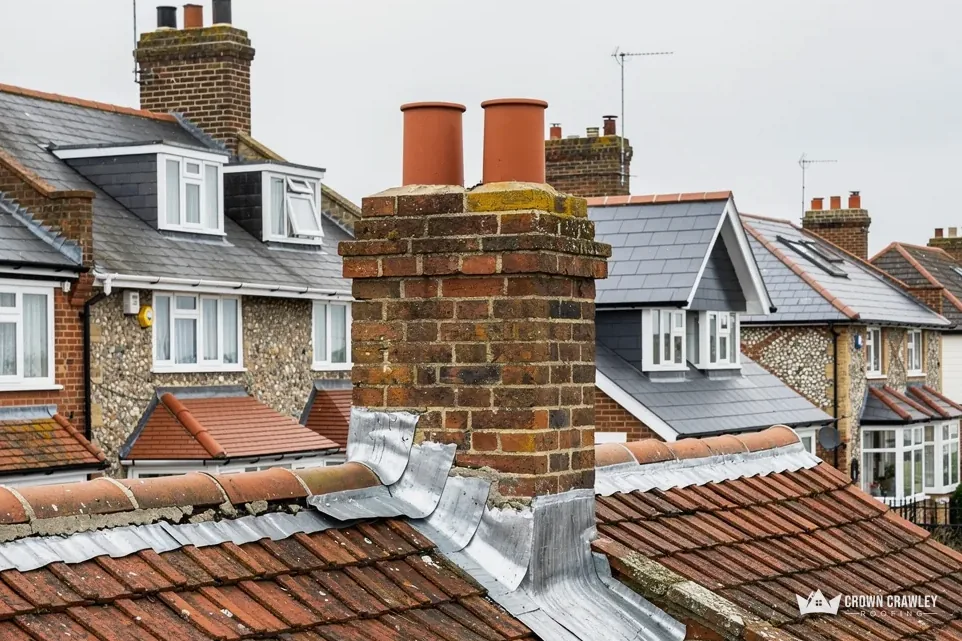 Commercial Roofing Materials: Balancing Durability and CostEvery commercial roof covering trades life against cost in a different way. This post compares felt, single-ply…Blog · 9 min read
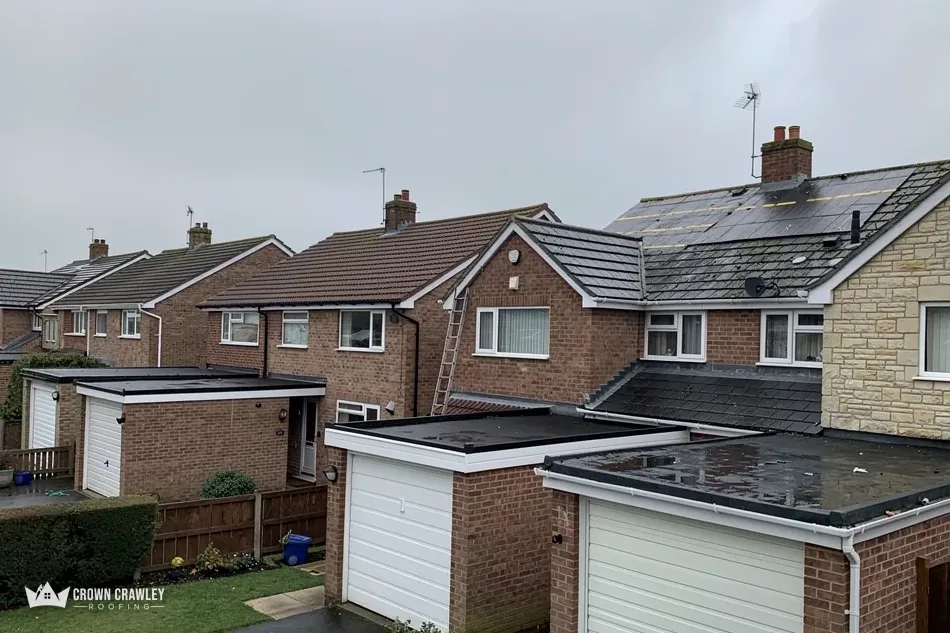 Choosing the Right Commercial Roofing ContractorA commercial roof is a bigger job than a house roof, with tenants, deliveries and fragile surfaces to think about.…Blog · 10 min read
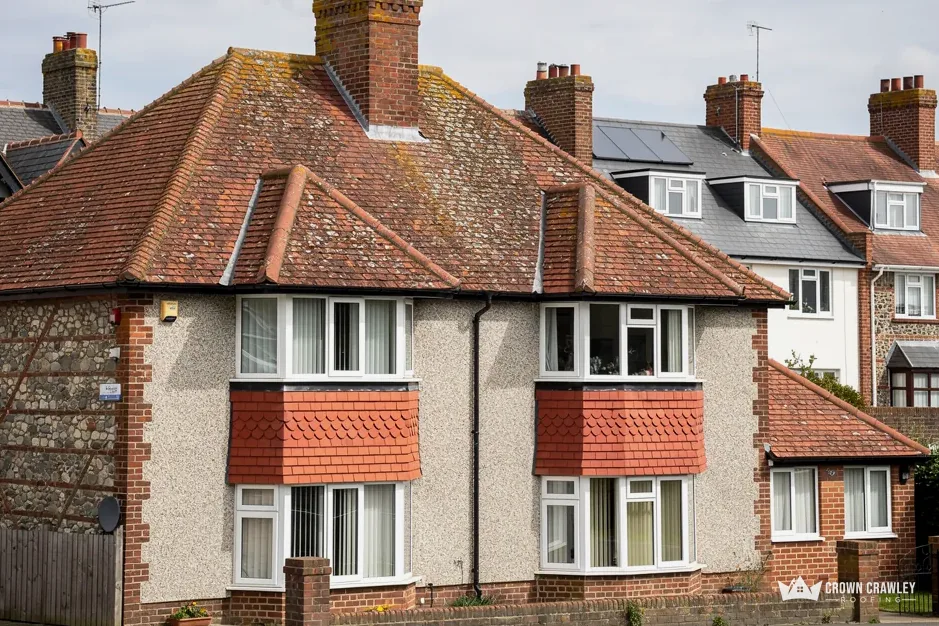 How Much Do Insulated Roof Panels Cost?Insulated roof panels arrive as one factory-made piece, so the price depends on thickness, core, finish and access…Blog · 10 min read
Quick answers
- Can Roof Repairs Go Ahead While a Business Is Open?
- Commercial Roof Replacement Cost per m2
- Who Pays for Commercial Roof Repairs Under a Lease?
- Industrial Roof Light Replacement
- Box Gutter Lining: Repair or Replace?
- Shop Flat Roof Repairs: What Owners Should Know
- How Often Should a Commercial Roof Be Inspected?
- Is EPDM Good for Commercial Roofs?
- Commercial Roof Coating vs Replacement
- Warehouse Roof Leaking: Common Causes
- Is There VAT on Commercial Roof Work?
- What Do the CDM Regulations Mean for Roof Work?
- Can My Commercial Roof Take Solar Panels?
- What Edge Protection Does Roof Work Need?
- Pigeon Proofing an Industrial Roof
- Roof Dilapidations at Lease End
- Replacing Metal Roof Sheets: Patch or Re-Sheet?
- How Long Does a Commercial Re-Roof Take?
- Commercial Roof Drainage Problems
- Do Commercial Roofs Need Fire-Rated Membranes?
Related services
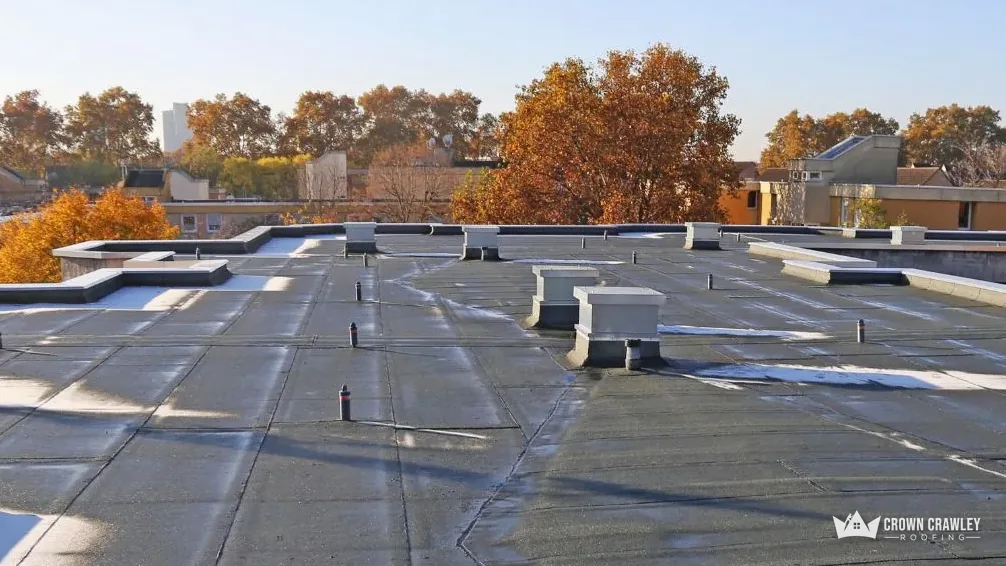 Flat roofingOur flat roofing service covers garage, extension, dormer and balcony roofs in Crawley and the towns around it: GRP…
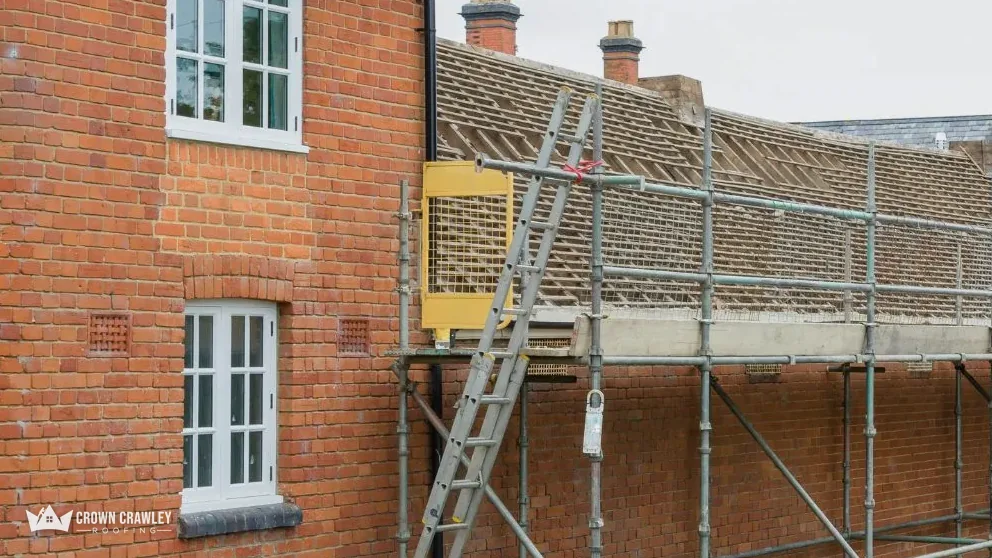 Roof replacementOur roof replacement service strips the whole roof and covers it again: new battens, underlay, tiles or slate, ridge…
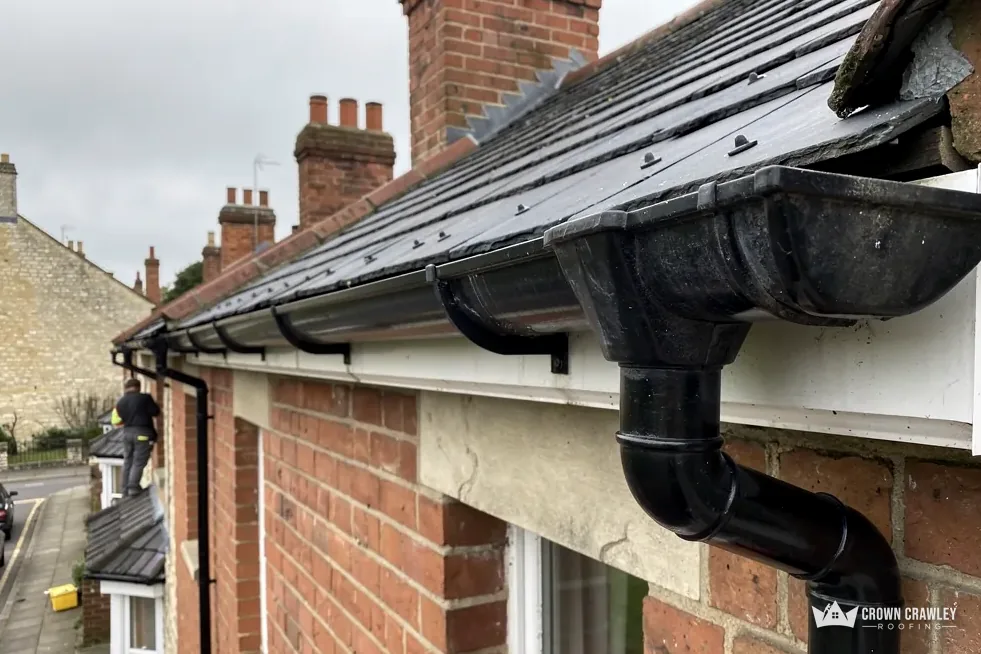 Gutters, soffits & fasciasWe replace fascias and soffits in Crawley and across Sussex, repair and clean guttering, and take out failing…
 Emergency roof repairsEmergency roof repairs in Crawley start with making the roof safe, then finding the real cause. We cover leaks, storm…
Commercial roofing questions
Can an asbestos cement roof be overclad instead of removed?
Sometimes, but it depends on the sheets, the frame and the survey. HSE says to assume asbestos in a building built or refurbished before 2000, and that asbestos cement roofs are always fragile. Overcladding leaves the sheets in place and adds weight, so the structure must carry it. We would want an asbestos survey and the drawings before giving you a price.
What does a manufacturer's warranty on a flat roof actually cover?
It covers what the manufacturer's paperwork says it covers, usually the system laid to their specification, for the period stated. That is a separate matter from how long the roof will last. Ask who gives it, what it excludes, whether it needs clear drains or inspections from you, and whether it passes to a new owner. Read the wording before you sign.
How is a repair programmed around a shift pattern?
We ask when the unit is busiest and quietest, where staff and vehicles move, and which areas hold stock or machines. The programme then puts loud fixing in quiet periods, keeps the working area fenced off and closes up each section before we leave. You get it in writing with the price and we tell you if the weather or the findings change it.
What should I do before a roofer reaches a leaking unit?
Move or cover stock and equipment, keep people away from wet floors, and keep water away from electrics. If water has reached electrical equipment, ask a qualified electrician to isolate it. Photograph the leak, the damage and the date. Note where water appears and in what weather, because that helps us trace it from the outside.
Is a Gatwick permit needed to lift sheets onto my roof?
Only if a crane or tall lifting equipment is used within 6km of the airport. Gatwick's page says there is an exception where the equipment is under 10m high or hidden from every side by taller trees or structures. If the lift is high and your site is near the airport, we check with Gatwick before booking it.
How do I tell whether a commercial re-roof quote is complete?
Ask what area and which roof lights, gutters, flashings and edges it covers, and whether it includes VAT, scaffolding or access equipment and waste removal. Ask what happens if the deck or insulation is found wet when the covering comes off. Compare totals for the same scope of work, and ask to see photographs of the roof as it stands.
Tell us where the unit leaks
Send the unit's address, a note of where water shows inside, and any roof plan or earlier survey you hold.